_________________________________________________________________________________
The Fabulous Furry Freak Brothers Omnibus
Written by Gilbert Shelton
Art by Gilbert Shelton, Dave Sheridan and Paul Mavrides
2008
Available now from Islington Libraries
You can reserve this item for free here:
http://www.library.islington.gov.uk/TalisPrism/
Growing up in Brixton my next door neighbour was a bald Scottish guy called Chris [1] who was - frankly - amazing. He had a job supplying comic books to shops or people (or something) which meant that he was big into comic books (which I guess (no duh) is why he got the job in the first place) which meant for me: my own personal comics library one door away with a crackling expert librarian who was always willing to recommend me the best selections of comics the world had to offer. "Oh Joel - read this." "Joel - I think you should try this." "Joel: I think you'll find this interesting." And thus was I introduced to: Judge Dredd, 2000AD, Alan Moore, Frank Miller (Sin City and Martha Washington I remember particularly), Garth Ennis' and the teenage delights of Preacher and - most especially: The Fabulous Furry Freak Brothers.
Most people would call this "corrupting a minor." Needless to say: I'm eternally grateful. (And Chris - if there's any small chance you're reading this: get in touch - I owe you a drink!).
Thanks to my upbringing: reading this big fat door-stopper of a book [2] was a bit like coming home
and a bit like rewatching Saturday morning cartoons: only now realising how strange it is that home if full of hippies sitting around taking various assortments of drugs and that the main storyline of the cartoons you enjoyed as a kid was based around a mean guy in a cowboy hat (that would be Freewheelin' Franklin) exhorting a bumbling, fat dope (that's Fat Freddy) to go out and score some dope (and hey - wouldn't it be great if there were more stories where the main catchphrase was:"Dope will get you through times of no money better than money will get you through times of no dope."?) Because of that: it's kinda hard for me to get much perceptive into how most people are going to react to meeting this loveable group of social-misfits: for me they're kinda up there with Mickey Mouse or Charlie Chaplin: beyond the passing whims and tastes of us mere mortals and more like permanent fixed point of the universe - just a sorta part of how things are: and not knowing about them is a bit like not knowing who Santa Claus is [3].
But hell: ok - if reading this is the first time you've ever even heard of "The Fabulous Furry Freak Brothers" let me try my best to clue you in: coming from a lineage that stretches all the way back to The Three Stooges and in slightly more modern times has resulted in such things as Up In Smoke [4] The Young Ones, Dumb and Dumber, Bottom, Kingpin, Red Dwarf, Dude, Where's My Car? and The Mighty Boosh. So yeah: that should give you some idea of what sorta thing we're dealing with: a group of stupid guys constantly battling against the slings and arrows of outrageous fortune - falling into scrapes, falling out of scrapes and doing all sorts of strange stuff but (altho of course this will depend on your own preferences and tastes): doing it all in a funny way.
For me it's kinda hard to pinpoint what particular decade the Freak Brothers live in (although maybe that's just because I'm not so great telling my historical periods apart). They first appeared in a publication called Feds 'n' Heads all the way back in 1968 but didn't really take off until The Collected Adventures of the Fabulous Furry Freak Brothers had its first printing in 1971 (from wikipedia: ". In addition to underground and college weekly newspapers, new adventures appeared in magazines such as Playboy, High Times, and Rip Off Comix; these too were collected in comic book form."). One of the closet reference points that spring to mind is Withnail and I: even if the sense of humour isn't really the same (Withnail and I being a lot more sly and subtle about things while the Freak Brothers (I guess in part because they're drawn and not played by real humans [5]) were always a bit more board and prone to fantastical situations and various kinds of slapstick) that whole dudes lying around and taking various types of drugs [6] with a sort of general malaise just floating over the top of all their heads. But then Withnail and I is kinda about the end of the 1960s so does that mean that's where the Freak Brothers best fit too? Or are they more creatures of the 1970s? Or does any of that really matter? Hell - it wouldn't really be too much of a stretch to imagine them somewhere around now: sitting in a bedsit somewhere and getting up to various types of no-good.
I guess that all this somewhat relevant as one of the things you should try and brace yourself for is that - especially during the first 100 pages (it gets better after that) some of the opinions and attitudes are a little - well "retrograde" would be one way to put it - "hopelessly backwards" would be another. I mean - I know that it's just a comic book but it's still a little much to read something where women are just "chicks" to "ball." and at one point there's someone called "General Gaylord" who has a "Homosexual Battalion!" It's the kind of thing that you just accept when you're young - but looking at it with older eyes it did make me feel a bit uncomfortable. The climax of this was a Freak Brothers story that basically climaxes with the punchline "and then everyone got raped." [7]: altho maybe that makes it sound much harsher than it actually comes across and (well this doesn't paint me in a great light) I've gotta admit that it did still make me laugh. So. I dunno [8]: maybe I'm just being a little bit too sensitive - it's not as if anyone really comes out with strong positive role-models: the freak brothers themselves aren't really people that you'd want to ever emulate: (not unless sitting around and smoking dope all day sounds like your idea of fun...). Plus: it does get better the further on you go: like when the female characters band together and use the democratic process to overthrown the Freak Brother's miniature version of the patriarchy.
One of the things that make it more than just about the ever-so slightly dodgy sexual politics and slapstick mucking about is the artwork [9]. At the start - yeah - it's all pretty basic and a little big ugly looking in it's bluntness. But stick with it for the first 100 pages and it soon blossoms into something else entirely. These aren't the kind of stories that short-change the reader with the lack of background detail - everything is always meticulously filled in and worked out and made to feel like a real place ("Hedgehog Stout Won't Kill You") and they're always willing to spend time getting the little things right - like the way that the hot air from a jet engine makes wavy lines.I didn't manage to keep track over who was doing the art (and there's three different artists on rotation: Gilbert Shelton, Dave Sheridan and Paul Mavrides) but whoever does what: it's all really beautiful especially when it gets to the big epic stories and switches to colour (unlike most long-running tv shows which tend to jump the shark [10] when they decide that it would be a good idea to move the characters to a new location ("The Simpsons are going to London!") pretty much all of the best Freak Brothers stories come from when they decide that they need to go somewhere: be it a bus tour across America (The Bus Line), a trip to the country (Grass Roots) or - for me the highlight of the whole collection - a trip around the world (The Idiots Aboard [11]]).
Coming slightly just before the halfway mark The Idiots Aboard is the point where the Freak Brothers go wide screen. It's like the rest of the time they're a black and white TV show built up out of five or ten minute sketches: and then with the Idiots Aboard they switch into glorious panoramic technicolor with a big-budget 3 hour movie epic that (somehow) manages to retain all the things that make them so much fun to read. I remember the first time I found The Idiots Aboard: it was a bit like discovering that George Lucas and Steven Spielberg had made an action-comedy together back in between Indiana Jones, Close Encounters of the Third Kind and I dunno - something else. In fact - maybe that Tintin film is a good example: only instead of a goody goody two shoes and his little white mutt (sorry Tintin) it's three dope smoking idiots trying to make their way to Columbia and getting hopelessly lost in the process. Featuring lines like (from an army type): "And when we get our hands on him we'll give him a fair, impartial military trail... and then we'll torture the son of a bitch to death!" and the least subtle religious parody I've ever seen ("Hallelujahgobble! Hallelujahgobble!") it's one of those stories that I know that after I've read it - it's going to leave me feeling good for the rest of the day [12].
I don't know how anyone could resist the charms of a series that includes songs like Let's All Get Drunk and Go Naked (sample lyric: "Let's all get drunk and go naked / All get drunk and go naked / All get drunk and go nayyy-kedddd / And lie in a great big pile!") and unfortunately writing all this down has left me too drained to extoll the virtues of Fat Freddy's Cat: but - damn - that is one cool feline.
If you're still undecided then my final attempt to get you to read it lies on the last page of the book: with a short six panel strip that never fails to make him guffaw in a major way. If you can find a copy of the book that I'd recommend that you just find a copy and skip over my attempts to recreate it (because it's always so great when someone goes: hey I saw this joke on a thing last night - let me try and recreate it for you!). I would have just linked to it if I could have found it somewhere online - but no such luck so you're stuck with this (brace yourself): Fat Freddy at a party looking around: "What a swell party! Where's the punch?." He finds a queue of people : "Excuse me" he asks "Is this the punch line?" "No you idiot" says the guy at the back of the queue "This is the beginning of the story." Fat Freddy walks away. Stops. Walks back. "Excuse me" he asks again. "Is this the punch line?" Guy at the back says: "Afraid so." "Such as it is."
Shut your face: That's pure brilliance.
....................................................................................................................................................
[1] No - I know what you're thinking: it wasn't Grant Morrison in disguise. Sorry.
[2] 624 pages - which makes it about 50 pages longer than From Hell. (So yeah - take that Alan Moore! Not so smart now are you?)
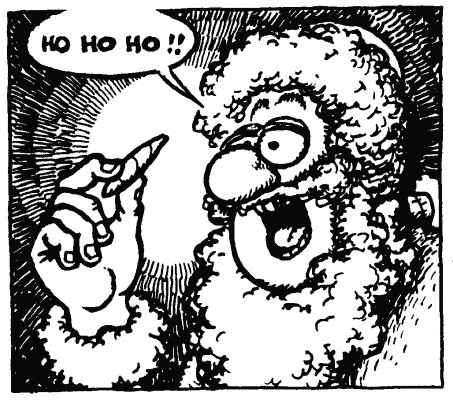
[3] Speaking of: I guess you have to read it in context but for whatever reason this is one of my favourite panels of the whole book: had me giggling like a loon for about 5 minutes after I read it: "Ho ho ho!!"
[4] Altho I haven't actually seen Up in Smoke so that's kinda a guess. But knowing about Cheech & Chong through the grapevine and reading what it says on wikipedia it sounds about right: ("a Grammy Award-winning comedy duo consisting of Richard "Cheech" Marin and Tommy Chong, who found a wide audience in the 1970s and 1980s for their films and stand-up routines, which were based on the hippie and free love era, and especially drug culture movements, most notably their love for cannabis.") In fact - do these guys owe Gilbert Shelton some royalties maybe?
[5] It's pretty telling that The Fabulous Furry Freak Brothers movie (which seems like it's got stuck in development hell - oh well) was going to portray them not with actors but with claymation: Wallace and Gromit style. Of course before that there have been quite a few unsuccessful attempts to bring the brothers to the big screen there was even an unauthorized pornographic film titled Up in Flames, which "ripped off the Freak Brothers, Mr. Natural and Cheech and Chong (them again!) all in one go." And in 1979 the guys who published the Freak Brothers - Rip Off Press (Gillbert Shelton himself and another guy called Jack Jackson (or "Jaxon" as his pen name has him)) got a big fat check from Universal Pictures ($250,000) for a five-year option on a live action film - which (so the story goes) was so they won't sue them for the Cheech and Chong franchise (damn that Cheech and Chong!)...
[6] And seeing how I grew up just round the corner from Camberwell I reckon that gives me some sort of right to link to this already much viewed little scene of brilliance ("Who says it's a Camberwell Carrot?" "I do. I invented it in Camberwell, and it looks like a carrot.")
[7] Which also features a drug-dealer ("Hey dig man: it's like the border crackdown has caused this immense
dope famine, and the prices have gone up.") who looks just like Bobby Gillespie from Primal Scream.
[8] I tried talking over some of these issues with my girlfriend and she said that she had read or heard something by Germaine Greer that said that "rape" shouldn't even exist as a seperate criminal offence and that all violent assault should just be categorised as violent assualt. But maybe we're getting off topic a little here from all the actual funny stuff...
[9] Even wikipedia seem impressed by it: "For a counterculture production, the standard of artwork is exceptionally high; Shelton's striving for accuracy and attention to detail have earned him comparisons with Hergé." (Funnily enough - altho Hergé wasn't a name that I was thinking of when I read this Freak Brothers book - I do get that people would join them together through the fact that both Shelton and Herge have a habit of designing in great detail all the machines and buildings that they feature in their stories: so much so that at some points they like to get their characters to pour over their blueprints (the moon rocket in Destination Moon and the skyfarm in The Idiots Aboard).
[10] I find it very difficult to imagine that anyone reading this (come on: it's a blog about comic books so I'm guessing that you must be fairly geeky) wouldn't know what "jumping the shark" means. But just in case: Jumping the shark is an idiom created by some guy called Jon Hein that basically is used to describe the moment in the point of a television show when it begins a decline in quality that is beyond recovery (as in: "boy - Friends sure jumped the shark with that 9/11 episode"). The phrase is also used to refer to a particular scene, episode or aspect of a show in which the writers use some type of "gimmick" in a desperate attempt to keep viewers' interest. The phrase jump the shark comes from a scene in Happy Days where the characters visit Los Angeles and a water-skiing Fonzie decides that it would be fun to jump over shark (and yes of course there's a website).
[11] Nope. No relation to this guy or this. At least - not as far as I know. (Hell I dunno - maybe Ricky Gervais is a secret Freak Brothers fan - it wouldn't surprise me).
[12] There is a bit of slump after Grass Roots where things just get a little bit silly and sloppy. But I read that one of the artists (Dave Sheridan) died in 1982 so maybe that has something to do with it.
....................................................................................................................................................
Links: Now Read This Review of Idiots Abroad.
Further reading: American Splendor: The Best of American Splendor, #$@&!: The Official Lloyd Llewellyn Collection, The Essential Dykes To Watch Out For, The Perry Bible Fellowship, Tank Girl: Tank Girl One, Breakdowns.
All comments welcome
Thursday, 6 September 2012
Books: Kick-Ass 2
________________________________________________________________________________
Kick-Ass 2
Written by Mark Millar
Art by John Romita Jr.
2012
Available now from Islington Libraries
You can reserve this item for free here:
http://www.library.islington.gov.uk/TalisPrism/
The introduction is by Joe Carnahan. I didn't know who Joe Carnahan is and he's much too full of himself to bother to include a little description underneath (he just signs off with his name and "Los Angeles, March 2012" - because - hey - that's all you need to know - right?). So I googled him and got: "Joseph Aaron "Joe" Carnahan (born May 9, 1969) is an American independent film director, screenwriter, producer and actor best known for his films Blood, Guts, Bullets and Octane, Narc, Smokin' Aces, The A-Team, and The Grey." I haven't seen any of these films but it felt like the first few paragraphs of the introduction told me everything that I would want to know (warning: contains potty-mouth): "Hey fucker. Let's face facts, you're one of these fucking fetishistic "fanboy" jerkoffs who secretly wishes that he could be Dave Lizewski, beating the shit out of muggers, gangbusters and mob heavies with those akimbo batons as a comely, prepubescent Hit Girl slashes and burns by your side. It's cool. Me too. I mean good money says that most of us already have our dicks in our hands and we're not even out of the intro... but just pace yourself pal and don't pop that nut just yet 'cuz what follows in these pages is one great white whale of a wank."
And - wow. I haven't even started to read the actual comic part of the comic and already I'm feeling well - uncomfortable and uneasy and a little put off. First of all it's all the swearing which just seemed a little - I dunno - unnecessary [1]. Then there's all that stuff about jacking off which is just kinda gross. I mean - yeah: birds do it, bees do it - even educated fleas do it: but that doesn't mean that I want it all over my introduction. And it's this whole sorta male jock thing that I just don't get: this macho pride in recounting your penis-related forays. That kinda stuff is an image that I just don't want to carry around inside my head. Plus: I don't really get why he describes it as being "one great white whale of a wank"? I guess - to give Joe Carnahan the benefit of the doubt it's a play on "whale of a time" (maybe?): but instead it just brings up associations with Moby Dick [2] and white whale meaning something that you obsess over to the point that it takes over your life until it destroys you which just makes the notion of one great white whale of a wank seem like something best avoided. But I guess the main thing that had me going "urg" was the description of prepubescent Hit Girl (who's supposed to be - what? - 11 years old?) as "comely." Because - well - (let me just put this as simply as I can) I'm not a paedophile. Sorry Joe.
So with an introduction that feels a little like someone spitting in your mouth [3] before you start eating your meal - once you get past that - what's the actual food like? Well: I guess I should have been prepared for something that was gonna taste that pretty but - well....
There was a part of me that was just thinking as I started reading this - maybe I'm just too old for this sorta stuff. Maybe I'm like a grandfather listening to Eminem or Odd Future or something and complaining it's all much too loud and violent while I shake my walking stick in the air ("damn kids!") and obviously it's the sworn duty of the younger generation to make and enjoy things that us oldies just can't fathom (I think I say all this because the reason Islington have Kick Ass 2 is because a teenager wanted a copy of it - and so in mind there's a big fat Kick Ass to youngsters correlation type thing). Except Mark Millar is (sorry Mark) no spring chicken and - well - since when did teenagers know which things are good and which things are bad? They're teenagers for godsakes!
So - no. If someone's just got beaten up and then they come up with a line like: "I feel like Rihanna after a quiet night in." - that's not really that funny: it's just kinda depressing. I mean - I don't want to get up too high on my horse of righteous indignation (I might fall off for one thing) but there's that line about how if you're not part of the solution then you're part of the problem. And Kick-Ass 2 feels very much part of the problem of a culture that's well - you know: mean and ugly and stupid (obviously culture has always been mean and ugly and stupid - but that's no real excuse). I mean - you don't want to finish reading a book and feel like you need to take a bath in order to wash all the dirt off. I mean - I don't want to sound like too much of a prude: but I prefer my entertainment without images of people shooting kids and depictions of sexual assault [4].
So yeah - in terms of sequelness it's not exactly The Dark Knight Strikes Again. There are no major revolutions: a different approach or a different style or anything like that. If you've read Kick-Ass then you can probably work out just what kind of things will happen before you ever start reading Kick-Ass 2. It's all just know - pushed a little further: more violent, more gross, more extreme (yeah bro: stands on a snowboard and makes devil-horns). It makes a few movements in the direction of being about empowerment or something ("How many rock stars settled for accountancy? How many astronauts grew up to be psychologists?" / "It's making a statement and being who you want to be.") but by the end it disintegrates into fighting and bloody noses.
On the back pages it promises that two more parts to the Kick-Ass saga (only maybe "threatens" would be a more accurate word): something which I regarded with a sense of despair rising up from the pit of my stomach. Which I don't think is so much of a good sign. Mark Millar has always had his haters who have grown more and more in number as the years have gone on. I mean - the first Kick-Ass left me a little sceptical but I remember there being a few meetings of the Comic Forum where I tried to stick up for (back when I was still a little wet behind the ears I guess): but this I guess is the point where me and Mark break ways.
See you later dude.
.........................................................................................................................................
[1] And that's coming from someone that still loves Preacher (the Garth Ennis and Steve Dillion comic book that pretty much makes swearing into some sort of beautiful art-form) and thought that The Aristocrats (the documentary not the Disney film) ended up feeling a little bit too tame (but then I guess that's sorta bound to happen when something is sold as being "the most vile, disgusting and vulgar film of all time.")
[2] And I can just imagine Joe Carnahan seeing that title and falling into fits of giggles. But let's try our best to move beyond such simple pleasures as dick-related puns (at least for the time being).
[3] What is this? New York?
[4] Of course just in case you think I'm being a hypocrite there are some books that I've talked about on here that depict the same sort of awful and horrendous things (Garth Ennis' Punisher Max series springs to mind). I guess the difference is that with something like the Punisher MAX it's all presented as being bad things and there's a sort of moral repulsion that comes with it. While Kick-Ass 2 just treats all these awful things as popcorn entertainment.
.........................................................................................................................................
Links: Comic Book Resources Review of 1# / #7, Guardian Review.
Further reading: Kick-Ass, Superior, Nemesis, Wanted, Preacher, The Boys,
Profiles: Mark Millar.
All comments welcome.
Kick-Ass 2
Written by Mark Millar
Art by John Romita Jr.
2012
Available now from Islington Libraries
You can reserve this item for free here:
http://www.library.islington.gov.uk/TalisPrism/
The introduction is by Joe Carnahan. I didn't know who Joe Carnahan is and he's much too full of himself to bother to include a little description underneath (he just signs off with his name and "Los Angeles, March 2012" - because - hey - that's all you need to know - right?). So I googled him and got: "Joseph Aaron "Joe" Carnahan (born May 9, 1969) is an American independent film director, screenwriter, producer and actor best known for his films Blood, Guts, Bullets and Octane, Narc, Smokin' Aces, The A-Team, and The Grey." I haven't seen any of these films but it felt like the first few paragraphs of the introduction told me everything that I would want to know (warning: contains potty-mouth): "Hey fucker. Let's face facts, you're one of these fucking fetishistic "fanboy" jerkoffs who secretly wishes that he could be Dave Lizewski, beating the shit out of muggers, gangbusters and mob heavies with those akimbo batons as a comely, prepubescent Hit Girl slashes and burns by your side. It's cool. Me too. I mean good money says that most of us already have our dicks in our hands and we're not even out of the intro... but just pace yourself pal and don't pop that nut just yet 'cuz what follows in these pages is one great white whale of a wank."
And - wow. I haven't even started to read the actual comic part of the comic and already I'm feeling well - uncomfortable and uneasy and a little put off. First of all it's all the swearing which just seemed a little - I dunno - unnecessary [1]. Then there's all that stuff about jacking off which is just kinda gross. I mean - yeah: birds do it, bees do it - even educated fleas do it: but that doesn't mean that I want it all over my introduction. And it's this whole sorta male jock thing that I just don't get: this macho pride in recounting your penis-related forays. That kinda stuff is an image that I just don't want to carry around inside my head. Plus: I don't really get why he describes it as being "one great white whale of a wank"? I guess - to give Joe Carnahan the benefit of the doubt it's a play on "whale of a time" (maybe?): but instead it just brings up associations with Moby Dick [2] and white whale meaning something that you obsess over to the point that it takes over your life until it destroys you which just makes the notion of one great white whale of a wank seem like something best avoided. But I guess the main thing that had me going "urg" was the description of prepubescent Hit Girl (who's supposed to be - what? - 11 years old?) as "comely." Because - well - (let me just put this as simply as I can) I'm not a paedophile. Sorry Joe.
So with an introduction that feels a little like someone spitting in your mouth [3] before you start eating your meal - once you get past that - what's the actual food like? Well: I guess I should have been prepared for something that was gonna taste that pretty but - well....
There was a part of me that was just thinking as I started reading this - maybe I'm just too old for this sorta stuff. Maybe I'm like a grandfather listening to Eminem or Odd Future or something and complaining it's all much too loud and violent while I shake my walking stick in the air ("damn kids!") and obviously it's the sworn duty of the younger generation to make and enjoy things that us oldies just can't fathom (I think I say all this because the reason Islington have Kick Ass 2 is because a teenager wanted a copy of it - and so in mind there's a big fat Kick Ass to youngsters correlation type thing). Except Mark Millar is (sorry Mark) no spring chicken and - well - since when did teenagers know which things are good and which things are bad? They're teenagers for godsakes!
So - no. If someone's just got beaten up and then they come up with a line like: "I feel like Rihanna after a quiet night in." - that's not really that funny: it's just kinda depressing. I mean - I don't want to get up too high on my horse of righteous indignation (I might fall off for one thing) but there's that line about how if you're not part of the solution then you're part of the problem. And Kick-Ass 2 feels very much part of the problem of a culture that's well - you know: mean and ugly and stupid (obviously culture has always been mean and ugly and stupid - but that's no real excuse). I mean - you don't want to finish reading a book and feel like you need to take a bath in order to wash all the dirt off. I mean - I don't want to sound like too much of a prude: but I prefer my entertainment without images of people shooting kids and depictions of sexual assault [4].
So yeah - in terms of sequelness it's not exactly The Dark Knight Strikes Again. There are no major revolutions: a different approach or a different style or anything like that. If you've read Kick-Ass then you can probably work out just what kind of things will happen before you ever start reading Kick-Ass 2. It's all just know - pushed a little further: more violent, more gross, more extreme (yeah bro: stands on a snowboard and makes devil-horns). It makes a few movements in the direction of being about empowerment or something ("How many rock stars settled for accountancy? How many astronauts grew up to be psychologists?" / "It's making a statement and being who you want to be.") but by the end it disintegrates into fighting and bloody noses.
On the back pages it promises that two more parts to the Kick-Ass saga (only maybe "threatens" would be a more accurate word): something which I regarded with a sense of despair rising up from the pit of my stomach. Which I don't think is so much of a good sign. Mark Millar has always had his haters who have grown more and more in number as the years have gone on. I mean - the first Kick-Ass left me a little sceptical but I remember there being a few meetings of the Comic Forum where I tried to stick up for (back when I was still a little wet behind the ears I guess): but this I guess is the point where me and Mark break ways.
See you later dude.
.........................................................................................................................................
[1] And that's coming from someone that still loves Preacher (the Garth Ennis and Steve Dillion comic book that pretty much makes swearing into some sort of beautiful art-form) and thought that The Aristocrats (the documentary not the Disney film) ended up feeling a little bit too tame (but then I guess that's sorta bound to happen when something is sold as being "the most vile, disgusting and vulgar film of all time.")
[2] And I can just imagine Joe Carnahan seeing that title and falling into fits of giggles. But let's try our best to move beyond such simple pleasures as dick-related puns (at least for the time being).
[3] What is this? New York?
[4] Of course just in case you think I'm being a hypocrite there are some books that I've talked about on here that depict the same sort of awful and horrendous things (Garth Ennis' Punisher Max series springs to mind). I guess the difference is that with something like the Punisher MAX it's all presented as being bad things and there's a sort of moral repulsion that comes with it. While Kick-Ass 2 just treats all these awful things as popcorn entertainment.
.........................................................................................................................................
Links: Comic Book Resources Review of 1# / #7, Guardian Review.
Further reading: Kick-Ass, Superior, Nemesis, Wanted, Preacher, The Boys,
Profiles: Mark Millar.
All comments welcome.
Tuesday, 4 September 2012
Books: Judge Dredd: The Complete Case Files 05
________________________________________________________________________________
Judge Dredd: The Complete Case Files 05
Written by John Wagner and Alan Grant
Art by Brian Bolland, John Cooper, Steve Dillon, Carlos Ezquerra, Ian Gibson, Mike McMahon, Barry Mitchell, Ron Smith and Colin Wilson
2006
Available now from Islington Libraries
You can reserve this item for free here:
http://www.library.islington.gov.uk/TalisPrism/
"Day 1. Today my new life began. At 9.45 this A.M. I broke into my block Citi-Def armoury and equipped myself with a variety of useful weapons. From this day on I have resolved to kill anyone who gets on my nerves."
That's a nice way to start and - well - just in case you didn't know it's an excellent summation of what the world of Judge Dredd is like: it's violent, mean and (if you've got the right sort of evil-infused funny bone) it's pretty damn funny too. And I guess the thing that's always struck me about Judge Dredd (and the thing that I'll do my best to try and explain here) is that he's just not like all the other varieties of tough guy future cop lawmen blah blah blah: opening up to the first page of this collection ("The Problem With Sonny Bono" [1]) and greeted by the sight of Dredd sitting on his lawmaster - gun already in hand was that there's something here that's special and unique and I don't know quite what: and that something is that Judge Dredd: all the way down to his very mean-ass core: is a total punk (which I guess is somewhat ironic seeing how he was partially based on Clint Eastwood/Dirty Harry whose first response to finding out that someone was a punk would be to get them to make this day and then - well: blow them away). I not just Dredd - but the whole of Mega City One and the rest of the future world he inhabits: it's a punk's idea of what the world has in store for us: It's the craziness that seeps from every pore and the non-stop "Block Wars" and that the anyone with a kind heart gets squashed beneath the wheels of progress without a second thought: One of the best examples of this happens in a story at the start of this collection that features Uncle Ump - a kindly old man who's like a cross between Colonel Sanders and Uncle Sam only with a much sweeter nature than both combined - who makes the mistake of inventing the world's most delicious candy that is so yummy that it becomes instantaneously addictive to anyone who tries it. Normally this would make him someone rich beyond their wildest dreams - but the danger to civil order is so great that the Judges put him on a rocket and send him out into space where - well - his final fate isn't pretty: but he's barely mourned before the story is moving forward and there's new all sorts of new stuff to deal with. Because - well - you want me quote some Sex Pistol lyrics? Fine: "We're the flowers in the dustbin. We're the poison in your human machine. We're the future, your future. There is no future in England's dreaming. No future for you, no future for me. No future, no future for you." So - yeah: it's not exactly utopian.
Whenever people talk about 2000AD [2] (which I should really try and stop spelling as one word - but - huh - "2000 AD" just doesn't look right for some reason) and how it came into being it's always Star Wars that gets mentioned. I think it's something the publishers saw that science-fiction was having a bit of a resurgence and they decided to hop on to the bandwagon with some futuristic comic fun: a bit of Dan Dare and some dinosaurs and maybe we can make some money - that sort of thing (and of course the obligatory mention of: hey - let's call it "2000AD" because what the hell: it'll never last that long - right?): and then Star Wars comes along and sales sky-rocketed and it became a British institution. Yay. But - for me at least - the year of 1977 (when 2000AD was launched) is famous for two different reasons: yes one of those reasons is to do with a young Aryan-looking lad with a magic glowing stick fighting space Nazis but the other reason was punk rock [3].
And that's the reason why Judge Dredd (like I've already said) is not like other future cops and Mega City One is not like other future cities: it's not all Blade Runner style flying cars and throngs of people (although to be far - it does have lots of those) and he's not a world-weary hero trying desperately to hold on to whatever small scrap of humanity he has left: Judge Dredd has no humanity (at least there's no sign of it in this collection) and you know what? That's just the way he likes it. Because like the cliché of a supehero being born when one small batch of chemicals gets contaminated by somesort of radioactive isotope (or whatever): Dredd is the mean tough lawgiver archetype infected with the radiation of the period he was created in: and that radiation was Johnny Rotten and people with safety pins pinned through their noses. And just look at him: I mean it's not as if other boys-action comic book characters are particularly elegant in the costumes they wear: I mean like I've already said several times on here how Batman just looks kinda silly with that cape and those sticky out pointy ears and we've all heard the snide remarks that have been made about the whole "pants over the trousers" look that superheroes like to rock: but Dredd kinda takes things to a whole new level. I mean back when I was a kid I used to like drawing pictures of stuff and characters from books that I had lying around and let me tell you - Dredd has all this tricksy stuff that can be a real pain in the bum to try and get right: there's the helmet sure - but there's also the badge, the big pad on one shoulder, the eagle on the other, the belt, the kneepads and the big boots. I remember reading somewhere once that the reason that superheroes always wear their distinctive skin-tight costumes is because when the comics used to come out in black and white they looked like their were naked and something about Freud and dreams of flying standing for other stuff and blah blah blah - point being (there's a point?): you'd never confuse Dredd with a naked person: he's all about the clothes and the hardware: the gun and the bike and all the rest of that sort of ornamental stuff. And come on: chains and shoulder pads and tight fitting leather as an official uniform? The only way that could make things more obvious is if he wore a T-Shirt that said "I Hate Pink Floyd." [5]
I get it that if you've never read Judge Dredd then it just seems like he's a cookie-cutter hard man who likes to shoot things and book perps: but the reason he's stuck around is because he's not a hero: he's more a conglomeration of all your worst excesses of law enforcement wrapped up into one tidy package. I mean: it's great fun to watch him go around and bash in people's heads: but every reader knows that things would be very different if you were the one living in the Mega City - because if you saw Dredd coming for you - you wouldn't want to greet him with open arms like he was your saviour - nah - the first and only thing you'd want to do would be to run.
But: of course all this yakking doesn't really tell you much about what's in this particular collection so let's quit the preamble and get down to it: the first bunch of stories in this are these self-contained little bite-sized things called "Mega Rackets" that are just "I wonder what ____ would be like in the future?" I mean - maybe if you've never read again Dredd before they'd be more entertaining: but for those of us who are already well used to all the future stuff it's a little bit by-the-numbers.
Then comes "Judge Death Lives!" which - shockingly - is only 5 parts long [6]: and yet manages to fit so much in - it feels a little bit like astronaut food: all your nutritional story and entertainments values compressed into one easy-to-swallow tablet. For those looking for a taster of why Judge Death is such a well-loved Judge Dredd character then there are much worse places to start - not only do you get a healthy dose of the alien super-fiend and his quotable-catchphrases ("The crime is life, the sentence is death!" etc) but you also get the first appearance of his "Three Killin' Cousins" who are each masterworks of iconic design (love the double-page spread of the four of them standing in a row like shop window dummies that almost just seems like showing off it's like the page is saying: check out how totally amazing these guys look!) and (perhaps most importantly) that most famous of all Judge Dredd panels: "Gaze into the fist of Dredd!" (just typing it gives me shivers).
But - and this is a testament to just how weighty things get - while anywhere else Judge Death Lives would be the main attraction - in this collection it's just a small appetizer before the ten course meal that is the bombastic epic: The Apocalypse War.
Now: I've read a lot of Judge Dredd back when I was kid and so most of the stuff (including the Judge Death stuff) I didn't even need to read. I just had to look at the first page and the whole story would come flooding back like a form of muscle-memory: I mean - this stuff is imprinted in a deep level of my brain that probably won't shift until the day I die. But The Apocalypse War - well - I'd never managed to get my hands on a collected version so to me it just had this mythical status as "best Dredd epic" ever and the one mega-story that all the ones that came after didn't come close to matching (sorry Necropolis, Judgement Day and (ha!) The Doomsday Scenario [7]). So finally getting to the point where I could actually read it. Well - let's just say that expectations were high.
Judge Dredd: The Complete Case Files 05
Written by John Wagner and Alan Grant
Art by Brian Bolland, John Cooper, Steve Dillon, Carlos Ezquerra, Ian Gibson, Mike McMahon, Barry Mitchell, Ron Smith and Colin Wilson
2006
Available now from Islington Libraries
You can reserve this item for free here:
http://www.library.islington.gov.uk/TalisPrism/
"Day 1. Today my new life began. At 9.45 this A.M. I broke into my block Citi-Def armoury and equipped myself with a variety of useful weapons. From this day on I have resolved to kill anyone who gets on my nerves."
That's a nice way to start and - well - just in case you didn't know it's an excellent summation of what the world of Judge Dredd is like: it's violent, mean and (if you've got the right sort of evil-infused funny bone) it's pretty damn funny too. And I guess the thing that's always struck me about Judge Dredd (and the thing that I'll do my best to try and explain here) is that he's just not like all the other varieties of tough guy future cop lawmen blah blah blah: opening up to the first page of this collection ("The Problem With Sonny Bono" [1]) and greeted by the sight of Dredd sitting on his lawmaster - gun already in hand was that there's something here that's special and unique and I don't know quite what: and that something is that Judge Dredd: all the way down to his very mean-ass core: is a total punk (which I guess is somewhat ironic seeing how he was partially based on Clint Eastwood/Dirty Harry whose first response to finding out that someone was a punk would be to get them to make this day and then - well: blow them away). I not just Dredd - but the whole of Mega City One and the rest of the future world he inhabits: it's a punk's idea of what the world has in store for us: It's the craziness that seeps from every pore and the non-stop "Block Wars" and that the anyone with a kind heart gets squashed beneath the wheels of progress without a second thought: One of the best examples of this happens in a story at the start of this collection that features Uncle Ump - a kindly old man who's like a cross between Colonel Sanders and Uncle Sam only with a much sweeter nature than both combined - who makes the mistake of inventing the world's most delicious candy that is so yummy that it becomes instantaneously addictive to anyone who tries it. Normally this would make him someone rich beyond their wildest dreams - but the danger to civil order is so great that the Judges put him on a rocket and send him out into space where - well - his final fate isn't pretty: but he's barely mourned before the story is moving forward and there's new all sorts of new stuff to deal with. Because - well - you want me quote some Sex Pistol lyrics? Fine: "We're the flowers in the dustbin. We're the poison in your human machine. We're the future, your future. There is no future in England's dreaming. No future for you, no future for me. No future, no future for you." So - yeah: it's not exactly utopian.
Whenever people talk about 2000AD [2] (which I should really try and stop spelling as one word - but - huh - "2000 AD" just doesn't look right for some reason) and how it came into being it's always Star Wars that gets mentioned. I think it's something the publishers saw that science-fiction was having a bit of a resurgence and they decided to hop on to the bandwagon with some futuristic comic fun: a bit of Dan Dare and some dinosaurs and maybe we can make some money - that sort of thing (and of course the obligatory mention of: hey - let's call it "2000AD" because what the hell: it'll never last that long - right?): and then Star Wars comes along and sales sky-rocketed and it became a British institution. Yay. But - for me at least - the year of 1977 (when 2000AD was launched) is famous for two different reasons: yes one of those reasons is to do with a young Aryan-looking lad with a magic glowing stick fighting space Nazis but the other reason was punk rock [3].
And that's the reason why Judge Dredd (like I've already said) is not like other future cops and Mega City One is not like other future cities: it's not all Blade Runner style flying cars and throngs of people (although to be far - it does have lots of those) and he's not a world-weary hero trying desperately to hold on to whatever small scrap of humanity he has left: Judge Dredd has no humanity (at least there's no sign of it in this collection) and you know what? That's just the way he likes it. Because like the cliché of a supehero being born when one small batch of chemicals gets contaminated by somesort of radioactive isotope (or whatever): Dredd is the mean tough lawgiver archetype infected with the radiation of the period he was created in: and that radiation was Johnny Rotten and people with safety pins pinned through their noses. And just look at him: I mean it's not as if other boys-action comic book characters are particularly elegant in the costumes they wear: I mean like I've already said several times on here how Batman just looks kinda silly with that cape and those sticky out pointy ears and we've all heard the snide remarks that have been made about the whole "pants over the trousers" look that superheroes like to rock: but Dredd kinda takes things to a whole new level. I mean back when I was a kid I used to like drawing pictures of stuff and characters from books that I had lying around and let me tell you - Dredd has all this tricksy stuff that can be a real pain in the bum to try and get right: there's the helmet sure - but there's also the badge, the big pad on one shoulder, the eagle on the other, the belt, the kneepads and the big boots. I remember reading somewhere once that the reason that superheroes always wear their distinctive skin-tight costumes is because when the comics used to come out in black and white they looked like their were naked and something about Freud and dreams of flying standing for other stuff and blah blah blah - point being (there's a point?): you'd never confuse Dredd with a naked person: he's all about the clothes and the hardware: the gun and the bike and all the rest of that sort of ornamental stuff. And come on: chains and shoulder pads and tight fitting leather as an official uniform? The only way that could make things more obvious is if he wore a T-Shirt that said "I Hate Pink Floyd." [5]
I get it that if you've never read Judge Dredd then it just seems like he's a cookie-cutter hard man who likes to shoot things and book perps: but the reason he's stuck around is because he's not a hero: he's more a conglomeration of all your worst excesses of law enforcement wrapped up into one tidy package. I mean: it's great fun to watch him go around and bash in people's heads: but every reader knows that things would be very different if you were the one living in the Mega City - because if you saw Dredd coming for you - you wouldn't want to greet him with open arms like he was your saviour - nah - the first and only thing you'd want to do would be to run.
But: of course all this yakking doesn't really tell you much about what's in this particular collection so let's quit the preamble and get down to it: the first bunch of stories in this are these self-contained little bite-sized things called "Mega Rackets" that are just "I wonder what ____ would be like in the future?" I mean - maybe if you've never read again Dredd before they'd be more entertaining: but for those of us who are already well used to all the future stuff it's a little bit by-the-numbers.
Then comes "Judge Death Lives!" which - shockingly - is only 5 parts long [6]: and yet manages to fit so much in - it feels a little bit like astronaut food: all your nutritional story and entertainments values compressed into one easy-to-swallow tablet. For those looking for a taster of why Judge Death is such a well-loved Judge Dredd character then there are much worse places to start - not only do you get a healthy dose of the alien super-fiend and his quotable-catchphrases ("The crime is life, the sentence is death!" etc) but you also get the first appearance of his "Three Killin' Cousins" who are each masterworks of iconic design (love the double-page spread of the four of them standing in a row like shop window dummies that almost just seems like showing off it's like the page is saying: check out how totally amazing these guys look!) and (perhaps most importantly) that most famous of all Judge Dredd panels: "Gaze into the fist of Dredd!" (just typing it gives me shivers).
But - and this is a testament to just how weighty things get - while anywhere else Judge Death Lives would be the main attraction - in this collection it's just a small appetizer before the ten course meal that is the bombastic epic: The Apocalypse War.
Now: I've read a lot of Judge Dredd back when I was kid and so most of the stuff (including the Judge Death stuff) I didn't even need to read. I just had to look at the first page and the whole story would come flooding back like a form of muscle-memory: I mean - this stuff is imprinted in a deep level of my brain that probably won't shift until the day I die. But The Apocalypse War - well - I'd never managed to get my hands on a collected version so to me it just had this mythical status as "best Dredd epic" ever and the one mega-story that all the ones that came after didn't come close to matching (sorry Necropolis, Judgement Day and (ha!) The Doomsday Scenario [7]). So finally getting to the point where I could actually read it. Well - let's just say that expectations were high.
Thankfully I wasn't let down.
I mean... I'm not sure how exactly to write down how The Apocalypse War affected me but I will say that by the end I was a little shell-shocked just kinda sitting there feeling a little dazed and gazing up into nothing going: "wow." (Is this hyping things up a little bit too much? Sorry). I mean on one hand it does seem like a little bit of a grind to have to slowly make your way through the stories at the first half of the book that are all just business-as-usual type typical day kinda stuff: but it really pays off in the long run because the grounding in the mundane nature of Mega City life makes the impact of nuclear war hit all the harder. I mean - it's not as if nuclear war needs help in making a spectacle: but you know it's like if you were watching Eastenders and it's all about hanging around the Queen Vic and who slept with who and all that and then - one day - they're all carrying kalashnikovs and eating the bodies of the dead because there's no more food left: it's more hardcore because you have such a good sense of what life was like before the war.
Also: I just love the way it builds. The beginnings of it are all just so comparatively humble and small-scale and even tho I knew what happened (thanks to The A to Z to Judge Dredd) I was still shocked when things started falling into place and the way that kept ramping things up until - well - they're blowing apart whole planets with nuclear missiles [8]. On the wikipedia page for The Apocalypse War (I wanted to see if I could find the exact reference but didn't have any luck - oh well) it says that one of the main impetuses for the storyline was that John Wagner and Alan Grant both felt that Mega City One had gotten too big and so they wanted to do something to bring it down to a more manageable size - the upshot of this for the reader (well - for me anyhow) is a sense of destruction and carnage that I don't think I've ever seen anywhere else in a comic (or - well - anywhere really [9]): in fact the best way I can think to describe it is - it's like you're a kid and you've just spent ages and ages and ages building up a big little city-thing out of lego (or whatever) - well The Apocalypse War is like your little brother or sister marching into the room and wantonly smashing their way through the whole thing with a manic grin on their face: that's the level of horror we're talking about here (I know I know - you might want to have a nice calming cup of tea standing by ready for when you're done).
But yeah: you wanna know what Judge Dredd is about - why he's awesome, why people keep trying to making films with him, why he's a British institution: you couldn't go much wrong with this collection.
...............................................................................................................................
[1] As drawn by Ian Gibson (even tho for some reason the credits on the page says it's by "Emberton"(?): I dunno maybe that was his pen-name or something?)
[2] And just in case there's some newbies who've only just joined us at the back: 2000AD is the weekly science-fiction anthology series that Judge Dredd appears in (well - at least until the 1990 when the Judge Dredd: The Megazine first appeared). But that's why ever part of of a Judge Dredd story comes in little 5 or 6 page chunks. (and seeing how Britain's other favourite science-fictional mainstay Doctor Who also (used to) come out in distinct "to be continued" parts - maybe there's some part of the national psyche that gets off on our entertainment being withholding? Or - I dunno - maybe it's just a hungover from rationing and that if people get everything that they wanted right away then they would just explode or something...
[3] Like it says on the wikipedia page for 1997 in music: "Perhaps most important is the beginning of what has become known as the punk rock explosion. 1977 was the year of formation of The Avengers, Bad Brains, Black Flag, Crass, Discharge, Fear, The Flesh Eaters, The Germs, The Misfits, 999, The Pagans, Plasmatics, VOM, The Weirdos, and X.1977 also saw the release of several pivotal albums in the development of punk music. Widely-acknowledged as masterpieces and among the earliest first full-length purely punk albums, The Clash by The Clash, The Damned's Damned, Damned, Damned, the Dead Boys' Young, Loud and Snotty, Johnny Thunders and the Heartbreakers' L.A.M.F., The Jam's In the City, the Ramones' Rocket to Russia, Richard Hell & the Voidoids' Blank Generation, the Sex Pistols' Never Mind the Bollocks, Here's the Sex Pistols, Television's Marquee Moon, and Wire's Pink Flag are usually considered their respective masterpieces, and kick-started punk music as the musical genre it eventually became". [4]
[4] Pretty sure that I've already linked to Baaaddad's Cliched Memories of Punk somewhere on here before - but what the hey: here you go again.
[5] And if you're looking to trash some of your illusions that check out this Guardian Interview: "John Lydon: I don't hate Pink Floyd: Contrary to his infamous T-shirt slogan, the punk-rock patriarch is such a fan of the prog-rock royals that he came close to accepting an invitation to perform live with them." (sigh).
[6] Which apparently is down to the fact that Brian Bolland (who's way more known now for drawing the covers to things like Grant Morrison's Doom Patrol and (urg) Fables) takes such a long time to finish his (frankly gorgeous-looking) artwork.
[7] The Doomsday Scenario is a story that came out back when I was reading 2000AD and The Judge Dredd Megazine and the build-up was so big and the let-down so huge and left me so disappointed that it's pretty much the reason why I decided to give up reading 2000AD and The Judge Dredd Megazine (and also: because - you know - comics are for kids and who wants to still be reading them when they're an adult and stuff? Ha).
[8] It's like the end of the criminally under-rated Terminator 3: only more so.
[9] Yeah there's Terminator 3 mentioned above - but goes the poetic route and shows you the destruction from space so it's hard to get a real sense of the horror. I guess that scene in T2 is more what I'm talking about - Sarah Conner rattling the fence at the playground (you all know the bit I mean - right?).
...............................................................................................................................
Links: Dredd Reckoning Review, Geek Syndicate Review.
Further reading: Judge Dredd: The Cursed Earth Saga, Judge Dredd: The Complete Case Files 06, Judge Dredd: The Complete Case Files 07, Judge Anderson: Satan, The Batman/Judge Dredd Files.
All comments welcome.
I mean... I'm not sure how exactly to write down how The Apocalypse War affected me but I will say that by the end I was a little shell-shocked just kinda sitting there feeling a little dazed and gazing up into nothing going: "wow." (Is this hyping things up a little bit too much? Sorry). I mean on one hand it does seem like a little bit of a grind to have to slowly make your way through the stories at the first half of the book that are all just business-as-usual type typical day kinda stuff: but it really pays off in the long run because the grounding in the mundane nature of Mega City life makes the impact of nuclear war hit all the harder. I mean - it's not as if nuclear war needs help in making a spectacle: but you know it's like if you were watching Eastenders and it's all about hanging around the Queen Vic and who slept with who and all that and then - one day - they're all carrying kalashnikovs and eating the bodies of the dead because there's no more food left: it's more hardcore because you have such a good sense of what life was like before the war.
Also: I just love the way it builds. The beginnings of it are all just so comparatively humble and small-scale and even tho I knew what happened (thanks to The A to Z to Judge Dredd) I was still shocked when things started falling into place and the way that kept ramping things up until - well - they're blowing apart whole planets with nuclear missiles [8]. On the wikipedia page for The Apocalypse War (I wanted to see if I could find the exact reference but didn't have any luck - oh well) it says that one of the main impetuses for the storyline was that John Wagner and Alan Grant both felt that Mega City One had gotten too big and so they wanted to do something to bring it down to a more manageable size - the upshot of this for the reader (well - for me anyhow) is a sense of destruction and carnage that I don't think I've ever seen anywhere else in a comic (or - well - anywhere really [9]): in fact the best way I can think to describe it is - it's like you're a kid and you've just spent ages and ages and ages building up a big little city-thing out of lego (or whatever) - well The Apocalypse War is like your little brother or sister marching into the room and wantonly smashing their way through the whole thing with a manic grin on their face: that's the level of horror we're talking about here (I know I know - you might want to have a nice calming cup of tea standing by ready for when you're done).
But yeah: you wanna know what Judge Dredd is about - why he's awesome, why people keep trying to making films with him, why he's a British institution: you couldn't go much wrong with this collection.
...............................................................................................................................
[1] As drawn by Ian Gibson (even tho for some reason the credits on the page says it's by "Emberton"(?): I dunno maybe that was his pen-name or something?)
[2] And just in case there's some newbies who've only just joined us at the back: 2000AD is the weekly science-fiction anthology series that Judge Dredd appears in (well - at least until the 1990 when the Judge Dredd: The Megazine first appeared). But that's why ever part of of a Judge Dredd story comes in little 5 or 6 page chunks. (and seeing how Britain's other favourite science-fictional mainstay Doctor Who also (used to) come out in distinct "to be continued" parts - maybe there's some part of the national psyche that gets off on our entertainment being withholding? Or - I dunno - maybe it's just a hungover from rationing and that if people get everything that they wanted right away then they would just explode or something...
[3] Like it says on the wikipedia page for 1997 in music: "Perhaps most important is the beginning of what has become known as the punk rock explosion. 1977 was the year of formation of The Avengers, Bad Brains, Black Flag, Crass, Discharge, Fear, The Flesh Eaters, The Germs, The Misfits, 999, The Pagans, Plasmatics, VOM, The Weirdos, and X.1977 also saw the release of several pivotal albums in the development of punk music. Widely-acknowledged as masterpieces and among the earliest first full-length purely punk albums, The Clash by The Clash, The Damned's Damned, Damned, Damned, the Dead Boys' Young, Loud and Snotty, Johnny Thunders and the Heartbreakers' L.A.M.F., The Jam's In the City, the Ramones' Rocket to Russia, Richard Hell & the Voidoids' Blank Generation, the Sex Pistols' Never Mind the Bollocks, Here's the Sex Pistols, Television's Marquee Moon, and Wire's Pink Flag are usually considered their respective masterpieces, and kick-started punk music as the musical genre it eventually became". [4]
[4] Pretty sure that I've already linked to Baaaddad's Cliched Memories of Punk somewhere on here before - but what the hey: here you go again.
[5] And if you're looking to trash some of your illusions that check out this Guardian Interview: "John Lydon: I don't hate Pink Floyd: Contrary to his infamous T-shirt slogan, the punk-rock patriarch is such a fan of the prog-rock royals that he came close to accepting an invitation to perform live with them." (sigh).
[6] Which apparently is down to the fact that Brian Bolland (who's way more known now for drawing the covers to things like Grant Morrison's Doom Patrol and (urg) Fables) takes such a long time to finish his (frankly gorgeous-looking) artwork.
[7] The Doomsday Scenario is a story that came out back when I was reading 2000AD and The Judge Dredd Megazine and the build-up was so big and the let-down so huge and left me so disappointed that it's pretty much the reason why I decided to give up reading 2000AD and The Judge Dredd Megazine (and also: because - you know - comics are for kids and who wants to still be reading them when they're an adult and stuff? Ha).
[8] It's like the end of the criminally under-rated Terminator 3: only more so.
[9] Yeah there's Terminator 3 mentioned above - but goes the poetic route and shows you the destruction from space so it's hard to get a real sense of the horror. I guess that scene in T2 is more what I'm talking about - Sarah Conner rattling the fence at the playground (you all know the bit I mean - right?).
...............................................................................................................................
Links: Dredd Reckoning Review, Geek Syndicate Review.
Further reading: Judge Dredd: The Cursed Earth Saga, Judge Dredd: The Complete Case Files 06, Judge Dredd: The Complete Case Files 07, Judge Anderson: Satan, The Batman/Judge Dredd Files.
All comments welcome.
Monday, 3 September 2012
Books: Seaguy
_________________________________________________________________________________
Seaguy
Written by Grant Morrison
Art by Cameron Stewart
2005
Available now from Islington Libraries
You can reserve this item for free here:
http://www.library.islington.gov.uk/TalisPrism/
"Zany" isn't a word that any right-thinking person wants to be associated with. When I hear if I think of Colin Hunt from the Fast Show [1] and I shudder all the way down past my bones into my very core.
Me and Grant Morrison. Well - our reader-writer relationship has never been smooth sailing. Unlike say Alan Moore or Garth Ennis or Warren Ellis who always pretty much manage to show my a good time and leave me feeling satisfied on somesort of emotional or intellectual level (or whatever) Grant Morrison has always been a little bit more - well - unreliable. Yeah - sometimes it's ice-creams and holding hands as we walk through the park and memories to last a lifetime [2] and then there's the times when after it's done I've left with a sore head and the sense that I've been left short-changed [3]. To put it at it's most simple: I don't like when he gets too zany: when he throws in a bunch of weird stuff and there's levitating wise-guy fishes (or: "Chubby Da Choona" as he's known to his friends), octopus shepherds and - obviously - talking Easter Island heads [4].
Because - yeah: if we're just sticking to one-word reviews: Seaguy is incredibly zany [5]. Hell: It's bonkers, goofy and madcap all mixed together in a great big vat of wacky. If your experience of comic books is mainly men in trenchcoats breaking people's fingers and doing lots of swearing: well - Seaguy is the popular opposite of that in much the same way that the opposite of a Martin Scorsese film is strawberry ice-cream (oh no - now I'm being zany!).
I first read Seaguy about - oooh - five years ago? I don't think I knew anything about it - it was just a something sitting on the shelves of my local library that looked kinda cool. Grant Morrison's name I guess I must have known from reading The Invisibles and The Filth. The Invisibles obviously had this big reputation as being this incredible epoch-defining comic-book masterwork. If I remember things right I think a friend lent me their whole collection so I'd read the whole thing in one big splurge - and altho there were bits about it that I really liked: by the time I reached the grand anti-climatic-seeming denouement I was a bit - well - disillusioned. And - The Filth - well: like I've said elsewhere on this site - The Filth is always gonna have a special place in my head and is not only my favourite Grant Morrison comic - but also pretty much one of my favourite comics period. So picking up Seaguy it felt like things could go either way: it could be this precise Filth-like masterwork that messed up my brain in all sorts of interesting ways or it could be more like an Invisibles-style mess.
Unfortunately for my oh-so-sensitive tastes Seaguy was (and is) way more on the Invisibles-style-free-for-all side of the Morrison spectrum (Morrisometer?): unlike some of his books which feel methodically planned and structured Seaguy - well - Seaguy reads like it was all just flinged on to the page with abandon: like Jackson Pollock only with words instead of paint. I mean - don't get me wrong - it looks very nice and Cameron Stewart's artwork is solid and everything looks properly defined and in proper proportion: but the story bounces from point-to-point like a pinball in a hurricane.
Since that point I didn't really give Seaguy a second thought. It was too strange and oddball and zany for me: whatever. The world is a big place and there are other books for me to read. But since that point this whole Comic Forum thing has happened and I've got drawn way more into the world of comic books and comic book blogging than I ever thought I would and I've got a bit more insider knowledge and comic book experience than I ever had before (yay me): and in reading all the stuff that other people have written about other comics and about Grant Morrison I kept bumping up against people mentioning Seaguy and talking about in glowing terms and saying it's a mini-masterpiece and stuff like that and even lamenting Grant Morrison as he is now (and the stuff he writes now) and going: oh man - why can't he just go back to more like when he was writing stuff like Seaguy?
Now: I don't know if you've read my post on Grant Morrison's Seven Soldiers of Victory - but the lesson I learnt there was that: even if you hate something the first time you read it - sometimes it can be worth going back and having another go. I mean - I thought Seven Soldiers was crazy zaniness the first time I read it - and I kinda put it aside thinking that it was unreadable - but going back I was pleasantly shocked by just how entertaining it was. So maybe the problem the first time round wasn't with Seaguy - maybe it was just me? Maybe there was something I was missing? Maybe it was actually this great work of art like the internet kept saying and maybe now was the time that I went back and discovered just exactly what it was that I was missing out on?
But no. Second time round was pretty much just like the first time round. There's this feeling of promise at the start - but then it just gets so weird and strange but still kinda aimless - like The Mighty Boosh but without the jokes or something or a sober-persons idea of what taking drugs must be like [6].
Of course - this is the point where all those comic nerds cleverer than me step in and go: ah. But you just didn't get it. You see actually if you read it right you'll see that actually the whole story is actually a beautifully worked out allegory for all sorts of stuff like growing up and finding your way, the unstoppable spread of totalitarian entertainment and the state of superhero comics [7]. And - you know what? - they're right. Seaguy is full of loads of clever little metaphors and things like that: my favourite being the evil brilliance of Mickey Eye: a cuddly corporate mascot as imagined by George Orwell and guaranteed to give children more nightmares than an entire night full of watching Doctor Who [8]. And - well - yeah - there's a feeling that sorta infuses the whole book that this isn't just about a kid called Seaguy having a wacky time: but it's actually aiming for something deeper and more profound [9].
But the thing is (at least for me) if you're telling a story that's allegorical: it's still got to have somesort of actual - well - story attached. Something that makes sense and feels vaguely consistent as opposed to just jumping around all over the place (that pinball in a hurricane again). I mean - Gulliver's Travels is a good example: because even tho that's chock-full to the brim of satire and inquires into human nature and all sorts of clever little symbolisms and funny allegorical set-pieces and things like that: it's still entertaining and enjoyable just on a "guy going on adventures" level (or as someone else put it: "It is universally read, from the cabinet council to the nursery"). Seaguy - well: I'm sure that some people could get a kick out of it - but for me it was like watching a cartoon with a personality disorder. Plus (well) it doesn't help that the book is kinda based on this whole "corporations are bad and evil" stance when nowadays Grant Morrison goes around saying stuff like: "I'm not the leader of a political party. I'm a freelance commercial writer who sells stories to pay the bills. I'm not an employee of any company except for the one run by me and my wife. I'm not a role model or the figurehead for any movement... I don't doubt that corporations can be underhanded, and I feel sorry for anyone who genuinely gets caught out. We live in a world where every day involves multiple negotiations with corporate power in one way or another, and all I can say is, enlist a lawyer to go through any contract before you sign it. Or self-publish." (which is just all sorts of disappointing [10]).
A small glimmer of hope: this is only the first book in a planned trilogy [11] and so maybe there is still a chance for the series to redeem itself with me. I mean - a big part of my problem with Seaguy is the way that crazy stuff just sorta happens and then isn't picked up on again (I liked the start of the stuff that happened with Xoo - but then there's things that happen in the middle that just left me confused and feeling like Morrison was just doing things because - hey - what the hell right?) and altho I can be ok with craziness - I really don't like it when stuff is left completely open-ended [12].
......................................................................................................................................................
[1] If you haven't witnessed him - well: he's a little like David Brent's younger cousin only with worse fashion sense. Don't say I didn't warn you.
[2] That would be: The Filth. Sebastian O. Marvel Boy. We3. All Star Superman. And anything else drawn by Frank Quitely.
[3] That's: parts of Doom Patrol (when the weirdness is turned up to 11). The last part of Vinanarama. The last part of The Invisibles. Basically anywhere where it gets a little bit too crazy and things stop making sense (yeah - basically I'm a total prude: what you gonna do?).
[4] A reference to Peter Milligan and Jamie Hewlett's Hewligan's Haircut perchance?
[5] Even that name seems a bit much. Although it was interesting to find out that apparently it comes from Grant Morrison's wife Kristan when he challenged to "think of the most stupidly perfect superhero name that hadn’t been used yet."
[6] This is where someone says - well: maybe that's the point? Like it says in the comic: “But… it seems so pointless. The rules so arbitrary,” “Well, that’s just how it is and it’s no good complaining.”
[7] According to sources elsewhere: part of the reason Seaguy came into being was down to the bad treatment Grant Morrison got from Marvel when he was working on his New X-Men series. Apparently there was a heavy-headed editorial policy or something which meant that he couldn't do all the crazy stuff that he wanted to (which would explain why the New X-Men does feel a little bit muted for a Grant Morrison production). And that would go a long way to explaining why Seaguy is such a splurge (I love that word) of over-the-top zaniness: it's like the mental breakdown that happens when someone's been suppressing all their deviant zany tendencies (or something).
[8] At first I couldn't put my finger on who Mickey Eye reminded me of - and just put my déjà vu down to the fact I'd already read Seaguy before until I realised that he looks like the hellish progenitor of everyone's least favourite Olympic mascots: Wenlock and Mandeville! (I know I already posted this when I was writing about Judge Dredd The Complete Case Files 07 but what the hey it's so good that I reckon it's worth repeating:" I bought this toy last week and although it arrived quickly and it seems to be well made, I have some concerns. Every fifteen minute since I've opened it out of the packaging, it will shout phrases such as 'I AM THE EYE OF PROVIDENCE', 'PAX ROMANA' and 'THE SECRET IS WITHIN THE GREAT PYRAMID OF GIZA'.") Because - regardless of what their clueless designer Grant Hunter may say ("Yes, cameras are everywhere in the UK and across the world. They are in your pockets (or bags) and incorporated into your smartphone. Having a camera on you at all times has become the norm. But since when has that become a negative? Cameras allow us to capture precious moments and that’s exactly how Wenlock and Mandeville use theirs. There’s no sinister subplot."): creatures with one giant staring eye: are totally freaking creepy.
[9] And I'm not just saying that because I've read Grant Morrison saying stuff like: "The first Seaguy stories were made up as a laugh but I soon realised the potential to do something big and resonant with the character.So it began as a series of weird, surreal routines then I decided I wanted to evolve it into something that was a bit ‘Don Quixote’, a bit ‘Candide’ and a little of the Celtic wonder tales I grew up on. I imagined a sci-fi ’Pilgrim’s Progress’ but with action and laughs and saw Seaguy as a way of telling the story of an entire human life through this character’s struggles and adventures."
[10] "I'm sorry that people were discouraged, but anyone who expects me to take any stronger 'stand' on this issue are going to be disappointed."
[11] Part 2 (Seaguy: Slaves of Mickey Eye) did come out in single-issue form back in 2009 but hasn't been released in a collected form yet and I don't know what's going on with part 3...
[12] I mean - obviously context (as always) is key. Put it this way: I wasn't one of those people that got angry when it got to the end of the Sopranos and no one had mentioned Valery: the unkillable Russian: "You're not gonna believe this. He killed sixteen Czechoslovakians. Guy was an interior decorator." (Like David Chase says: "They shot a guy.Who knows where he went? Who cares about some Russian? This is what Hollywood has done to America. Do you have to have closure on every little thing? Isn't there any mystery in the world? It's a murky world out there. It's a murky life these guys lead. And by the way, I do know where the Russian is. But I'll never say because so many people got so pissy about it.")
......................................................................................................................................................
Links: Jog The Blog Review: The Contours of Artificiality (the pretentious title for my SPOILER-LOADED Seaguy review), 4th Letter Review: Pre-Crisis 4l: Seaguy #1 and Why I Suck, Fourth Age of Comics Review, Graphic Novel Reporter Review, Wit War Review, Thoughts on Stuff Review, Wright Opinion Article: Morrison Beyond Supergods.
Further reading: The Filth, Seven Soldiers of Victory, Hewligan's Haircut, Vimanarama, The Bulletproof Coffin, The Invisibles, Flex Mentallo, The Arrival, Dan and Larry in Don't Do That!, David Boring, Stray Toasters.
Profiles: Grant Morrison.
All comments welcome.
Seaguy
Written by Grant Morrison
Art by Cameron Stewart
2005
Available now from Islington Libraries
You can reserve this item for free here:
http://www.library.islington.gov.uk/TalisPrism/
"Zany" isn't a word that any right-thinking person wants to be associated with. When I hear if I think of Colin Hunt from the Fast Show [1] and I shudder all the way down past my bones into my very core.
Me and Grant Morrison. Well - our reader-writer relationship has never been smooth sailing. Unlike say Alan Moore or Garth Ennis or Warren Ellis who always pretty much manage to show my a good time and leave me feeling satisfied on somesort of emotional or intellectual level (or whatever) Grant Morrison has always been a little bit more - well - unreliable. Yeah - sometimes it's ice-creams and holding hands as we walk through the park and memories to last a lifetime [2] and then there's the times when after it's done I've left with a sore head and the sense that I've been left short-changed [3]. To put it at it's most simple: I don't like when he gets too zany: when he throws in a bunch of weird stuff and there's levitating wise-guy fishes (or: "Chubby Da Choona" as he's known to his friends), octopus shepherds and - obviously - talking Easter Island heads [4].
Because - yeah: if we're just sticking to one-word reviews: Seaguy is incredibly zany [5]. Hell: It's bonkers, goofy and madcap all mixed together in a great big vat of wacky. If your experience of comic books is mainly men in trenchcoats breaking people's fingers and doing lots of swearing: well - Seaguy is the popular opposite of that in much the same way that the opposite of a Martin Scorsese film is strawberry ice-cream (oh no - now I'm being zany!).
I first read Seaguy about - oooh - five years ago? I don't think I knew anything about it - it was just a something sitting on the shelves of my local library that looked kinda cool. Grant Morrison's name I guess I must have known from reading The Invisibles and The Filth. The Invisibles obviously had this big reputation as being this incredible epoch-defining comic-book masterwork. If I remember things right I think a friend lent me their whole collection so I'd read the whole thing in one big splurge - and altho there were bits about it that I really liked: by the time I reached the grand anti-climatic-seeming denouement I was a bit - well - disillusioned. And - The Filth - well: like I've said elsewhere on this site - The Filth is always gonna have a special place in my head and is not only my favourite Grant Morrison comic - but also pretty much one of my favourite comics period. So picking up Seaguy it felt like things could go either way: it could be this precise Filth-like masterwork that messed up my brain in all sorts of interesting ways or it could be more like an Invisibles-style mess.
Unfortunately for my oh-so-sensitive tastes Seaguy was (and is) way more on the Invisibles-style-free-for-all side of the Morrison spectrum (Morrisometer?): unlike some of his books which feel methodically planned and structured Seaguy - well - Seaguy reads like it was all just flinged on to the page with abandon: like Jackson Pollock only with words instead of paint. I mean - don't get me wrong - it looks very nice and Cameron Stewart's artwork is solid and everything looks properly defined and in proper proportion: but the story bounces from point-to-point like a pinball in a hurricane.
Since that point I didn't really give Seaguy a second thought. It was too strange and oddball and zany for me: whatever. The world is a big place and there are other books for me to read. But since that point this whole Comic Forum thing has happened and I've got drawn way more into the world of comic books and comic book blogging than I ever thought I would and I've got a bit more insider knowledge and comic book experience than I ever had before (yay me): and in reading all the stuff that other people have written about other comics and about Grant Morrison I kept bumping up against people mentioning Seaguy and talking about in glowing terms and saying it's a mini-masterpiece and stuff like that and even lamenting Grant Morrison as he is now (and the stuff he writes now) and going: oh man - why can't he just go back to more like when he was writing stuff like Seaguy?
Now: I don't know if you've read my post on Grant Morrison's Seven Soldiers of Victory - but the lesson I learnt there was that: even if you hate something the first time you read it - sometimes it can be worth going back and having another go. I mean - I thought Seven Soldiers was crazy zaniness the first time I read it - and I kinda put it aside thinking that it was unreadable - but going back I was pleasantly shocked by just how entertaining it was. So maybe the problem the first time round wasn't with Seaguy - maybe it was just me? Maybe there was something I was missing? Maybe it was actually this great work of art like the internet kept saying and maybe now was the time that I went back and discovered just exactly what it was that I was missing out on?
But no. Second time round was pretty much just like the first time round. There's this feeling of promise at the start - but then it just gets so weird and strange but still kinda aimless - like The Mighty Boosh but without the jokes or something or a sober-persons idea of what taking drugs must be like [6].
Of course - this is the point where all those comic nerds cleverer than me step in and go: ah. But you just didn't get it. You see actually if you read it right you'll see that actually the whole story is actually a beautifully worked out allegory for all sorts of stuff like growing up and finding your way, the unstoppable spread of totalitarian entertainment and the state of superhero comics [7]. And - you know what? - they're right. Seaguy is full of loads of clever little metaphors and things like that: my favourite being the evil brilliance of Mickey Eye: a cuddly corporate mascot as imagined by George Orwell and guaranteed to give children more nightmares than an entire night full of watching Doctor Who [8]. And - well - yeah - there's a feeling that sorta infuses the whole book that this isn't just about a kid called Seaguy having a wacky time: but it's actually aiming for something deeper and more profound [9].
But the thing is (at least for me) if you're telling a story that's allegorical: it's still got to have somesort of actual - well - story attached. Something that makes sense and feels vaguely consistent as opposed to just jumping around all over the place (that pinball in a hurricane again). I mean - Gulliver's Travels is a good example: because even tho that's chock-full to the brim of satire and inquires into human nature and all sorts of clever little symbolisms and funny allegorical set-pieces and things like that: it's still entertaining and enjoyable just on a "guy going on adventures" level (or as someone else put it: "It is universally read, from the cabinet council to the nursery"). Seaguy - well: I'm sure that some people could get a kick out of it - but for me it was like watching a cartoon with a personality disorder. Plus (well) it doesn't help that the book is kinda based on this whole "corporations are bad and evil" stance when nowadays Grant Morrison goes around saying stuff like: "I'm not the leader of a political party. I'm a freelance commercial writer who sells stories to pay the bills. I'm not an employee of any company except for the one run by me and my wife. I'm not a role model or the figurehead for any movement... I don't doubt that corporations can be underhanded, and I feel sorry for anyone who genuinely gets caught out. We live in a world where every day involves multiple negotiations with corporate power in one way or another, and all I can say is, enlist a lawyer to go through any contract before you sign it. Or self-publish." (which is just all sorts of disappointing [10]).
A small glimmer of hope: this is only the first book in a planned trilogy [11] and so maybe there is still a chance for the series to redeem itself with me. I mean - a big part of my problem with Seaguy is the way that crazy stuff just sorta happens and then isn't picked up on again (I liked the start of the stuff that happened with Xoo - but then there's things that happen in the middle that just left me confused and feeling like Morrison was just doing things because - hey - what the hell right?) and altho I can be ok with craziness - I really don't like it when stuff is left completely open-ended [12].
......................................................................................................................................................
[1] If you haven't witnessed him - well: he's a little like David Brent's younger cousin only with worse fashion sense. Don't say I didn't warn you.
[2] That would be: The Filth. Sebastian O. Marvel Boy. We3. All Star Superman. And anything else drawn by Frank Quitely.
[3] That's: parts of Doom Patrol (when the weirdness is turned up to 11). The last part of Vinanarama. The last part of The Invisibles. Basically anywhere where it gets a little bit too crazy and things stop making sense (yeah - basically I'm a total prude: what you gonna do?).
[4] A reference to Peter Milligan and Jamie Hewlett's Hewligan's Haircut perchance?
[5] Even that name seems a bit much. Although it was interesting to find out that apparently it comes from Grant Morrison's wife Kristan when he challenged to "think of the most stupidly perfect superhero name that hadn’t been used yet."
[6] This is where someone says - well: maybe that's the point? Like it says in the comic: “But… it seems so pointless. The rules so arbitrary,” “Well, that’s just how it is and it’s no good complaining.”
[7] According to sources elsewhere: part of the reason Seaguy came into being was down to the bad treatment Grant Morrison got from Marvel when he was working on his New X-Men series. Apparently there was a heavy-headed editorial policy or something which meant that he couldn't do all the crazy stuff that he wanted to (which would explain why the New X-Men does feel a little bit muted for a Grant Morrison production). And that would go a long way to explaining why Seaguy is such a splurge (I love that word) of over-the-top zaniness: it's like the mental breakdown that happens when someone's been suppressing all their deviant zany tendencies (or something).
[8] At first I couldn't put my finger on who Mickey Eye reminded me of - and just put my déjà vu down to the fact I'd already read Seaguy before until I realised that he looks like the hellish progenitor of everyone's least favourite Olympic mascots: Wenlock and Mandeville! (I know I already posted this when I was writing about Judge Dredd The Complete Case Files 07 but what the hey it's so good that I reckon it's worth repeating:" I bought this toy last week and although it arrived quickly and it seems to be well made, I have some concerns. Every fifteen minute since I've opened it out of the packaging, it will shout phrases such as 'I AM THE EYE OF PROVIDENCE', 'PAX ROMANA' and 'THE SECRET IS WITHIN THE GREAT PYRAMID OF GIZA'.") Because - regardless of what their clueless designer Grant Hunter may say ("Yes, cameras are everywhere in the UK and across the world. They are in your pockets (or bags) and incorporated into your smartphone. Having a camera on you at all times has become the norm. But since when has that become a negative? Cameras allow us to capture precious moments and that’s exactly how Wenlock and Mandeville use theirs. There’s no sinister subplot."): creatures with one giant staring eye: are totally freaking creepy.
[9] And I'm not just saying that because I've read Grant Morrison saying stuff like: "The first Seaguy stories were made up as a laugh but I soon realised the potential to do something big and resonant with the character.So it began as a series of weird, surreal routines then I decided I wanted to evolve it into something that was a bit ‘Don Quixote’, a bit ‘Candide’ and a little of the Celtic wonder tales I grew up on. I imagined a sci-fi ’Pilgrim’s Progress’ but with action and laughs and saw Seaguy as a way of telling the story of an entire human life through this character’s struggles and adventures."
[10] "I'm sorry that people were discouraged, but anyone who expects me to take any stronger 'stand' on this issue are going to be disappointed."
[11] Part 2 (Seaguy: Slaves of Mickey Eye) did come out in single-issue form back in 2009 but hasn't been released in a collected form yet and I don't know what's going on with part 3...
[12] I mean - obviously context (as always) is key. Put it this way: I wasn't one of those people that got angry when it got to the end of the Sopranos and no one had mentioned Valery: the unkillable Russian: "You're not gonna believe this. He killed sixteen Czechoslovakians. Guy was an interior decorator." (Like David Chase says: "They shot a guy.Who knows where he went? Who cares about some Russian? This is what Hollywood has done to America. Do you have to have closure on every little thing? Isn't there any mystery in the world? It's a murky world out there. It's a murky life these guys lead. And by the way, I do know where the Russian is. But I'll never say because so many people got so pissy about it.")
......................................................................................................................................................
Links: Jog The Blog Review: The Contours of Artificiality (the pretentious title for my SPOILER-LOADED Seaguy review), 4th Letter Review: Pre-Crisis 4l: Seaguy #1 and Why I Suck, Fourth Age of Comics Review, Graphic Novel Reporter Review, Wit War Review, Thoughts on Stuff Review, Wright Opinion Article: Morrison Beyond Supergods.
Further reading: The Filth, Seven Soldiers of Victory, Hewligan's Haircut, Vimanarama, The Bulletproof Coffin, The Invisibles, Flex Mentallo, The Arrival, Dan and Larry in Don't Do That!, David Boring, Stray Toasters.
Profiles: Grant Morrison.
All comments welcome.
Friday, 31 August 2012
Books: Tintin: Tintin in the Land of the Soviets
________________________________________________________________________________
Tintin: Tintin in the Land of the Soviets
By Hergé
1930
Available now from Islington Libraries
You can reserve this item for free here:
http://www.library.islington.gov.uk/TalisPrism/
So: as you can probably tell by now I'm a Tintin fan from way, way, way back. The thrilling (and slapstick-filled) adventures of Belgian's most famous young boy reporter have kept me enthralled since I was first able to read [1]. In fact it was a bit of (what I thought would be) a life-long mission: that is one of my goals in life was to read every Tintin book available [2]: one that I thought that I had completed when I finally finally managed to read The Red Sea Sharks [3].
Of course you should never underestimate the lengths people/the publishing industry/Capitalism will go to in order to make a quick buck - as since that point there's been a "clearing of the vaults" so to speak (and I'm sure that someone, somewhere as put this down to: massive public demand!) and so now have "new" Tintin books [4] in the shape of: Tintin in the Congo, Tintin and Alph-Art [5] and (dur! dur! dur!): Tintin in the Land of the Soviets.
I was actually at another Islington library (the lovely little West Library) when I saw this book just sitting on their shelves and had picked it up and taken it home before I even realised what I was doing. I guess it was the old "gotta read them all" instinct kicking in: although I tried my best to rationalise it to myself by going - it'll be a good book to bring to the Comic Forum - you know: the early days of comics and all that.
Well. I was right about it that. I mean - I would have to go and double-check but thinking it over I'm fairly certain that this is the oldest book that I've written about on here: to try and put this in perspective: In 1930 Mickey Mouse was only a couple of years old (and had only just appeared in his first ever comic strip), Jack Kirby would have only been about 13 and Superman wasn't going to be invented until 1932. I mean: this is practically the Triassic period in terms of comic book history: so I guess I shouldn't have been surprised that things were gonna feel - well - a little ancient. But I guess I just wasn't properly prepared for just how basic this book was going to feel: it was a little like going from riding around in a car to holding on the side of a stone wheel as it bounces down a hill.
I mean: the first thing to hit me was just how completely amateur the art looks. I mean - when the book starts it looks like the kind of stuff that if someone sent it to a publisher nowadays they would get a note back saying "thank but no thanks - maybe in a few more years when you've worked out how to draw human beings." But back in the 1930s this stuff was good enough to be published in a national newspaper [6]. Still: that doesn't take away from how disconcerting it is to see Tintin looking like somesort of strange half mutant child dressed up in human clothes (things do gradually improve tho until towards the end he finally begins to resemble a real boy) [7]. The other thing to hit me was - well - all the violence. To be clear: even tho this is the 21st Century and we're all desensitized and I (obviously) have read a lot of superhero comic books where everyone's always looking for an excuse to have a brawl ("Who are you?" "I dunno - but let's fight!") I was somewhat taken aback by just how much fighting there was. I mean - this is supposed to be an innocent little Tintin book but there's just loads and loads and loads of fighting (and everyone standing around in boxing poses - fists raised, legs apart that sorta thing): you can practically feel the violence radiating off the page. I mean back in the strange days before things like the internet and television there wasn't much else to do but go and watch people beat the hell out of each other: but still.
But then I guess the main over-riding feature of this book is just how - well - racist it is [8]. I mean - I knew it wasn't exactly going to be politically correct or anything like that: but well I didn't know that I was going to get dialogue like: "Have you an outfit in my size?" "I zink zo, my liddle fren.'" According to the ever-reliable wikipedia it was written with the express purpose of being a work of anti-communist propaganda for children: but even with that in mind it still comes across as being a bit strong. Examples: apparently Russians are prone to saying things like: "By Trotsky!" and "I think the dirty little bourgeois is asleep." and they like to kill time by idly tying stones around the necks of dogs and throwing them into rivers. And my favourite bit: when he discovers the underground hideout where Lenin, Trotsky and Stalin collect together all the wealth they've stolen from the people (omg). And none of this is helped by Tintin endlessly pontificating about the evils of Soviet Russia like a spokesperson in a cut-rate propaganda reel [9]: "While the Russian people are dying of hunger, immense quantities of wheat are being sent abroad to prove the so-called wealth of the Soviet Paradise."and "Look at what the Soviets have done to the beautiful city of Moscow: a stinking slum!" and (towards the end) "Goodbye, unfriendly country!" (lovely) [10].
There are a lots of pages (more so than the other Tintin books) - but it (mainly) restricts itself to a six panel grid but that's not really helped by the way it all feels so aimless and listless with one thing happening after another with no real sense of consequence: stealing cars, finding a diving suit, joining the army, going up against the firing squad, designing himself as a pilot - whatever. It all feels as un-involving as watching someone else play a computer game. With cliffhangers resolved in the most unlikely of ways: "As for you, you've penetrated our secret, so you will be killed... (turns page) ...Tomorrow, at dawn."
Praise? I liked it that Snowy's sarcastic and slightly world-weary voice was already pretty much fully formed: When they find a fake factory (like an old-fashioned film set: only the outside is real) they step behind to find someone smashing plates and sheets of iron in order to make it seem like there are people working and Snowy quips: "It must be a Russian jazz band." which I'll admit I found pretty funny (good old Snowy). And there's a bit when Tintin drinks too much champagne and sees multiple keyholes that's kinda cool. But that's just one panel in a whole book - so not really worth the price of entry.
And this die-hard Tintin fan did get a small kick from noticing the same poses peeking through the artwork: the way that Tintin does his celebratory dancing with his arms outstrectched and grabbing Snowy by the hands, the angle of the way trains speed towards the reader or the boats crash through the water and how the people bump into trees with all their limbs extended: it's like glimpses of the finished machine hidden within the depths of the prototype.
Maybe then it's just one for the die-hard completists and comic book historians.
..............................................................................................................................................
[1] In fact one of my party tricks when I was about 8 or 9 (if it makes sense to talk about party tricks when you're not actually old enough to go to a proper party) was based around just how many times I'd read Tintin: The Black Island. If someone else read a single line of dialogue I could tell you who said it, why the said it and what which other lines came both before and after it. Needless to say: I was a total chick-magnet.
[2] Gotta say: it was super-canny move on the part of the publishers to put the covers of all the Tintin books on the back cover in a super-appealing-looking grid formation: looking like jars of multi-coloured candy in a sweet shop window. As soon as you finish one book it's always what I would find myself staring at: I could hear them calling to me: "read us! read us!".
[3] Which is kinda a strange book to read as your final Tintin book as it manages to pack in cameos from pretty much every other Tintin book - including (deep breath): General Alcazar; Emir Ben Kalish Ezab and Abdullah; Rastapopoulos; Oliveira da Figueira; Doctor Müller; Dawson; Allan Thompson; Bianca Castafiore and Jolyon Wagg. So it feels a little bit like a school reunion or (actually this more accurately describes the feeling of reading it): a wake.
[4] Well - actually - they've been out for quite a few years now - but gimme a break.
[5] Islington don't actually have a copy of Tintin and Alph-Art but I'd say that can only be a good thing. I managed to hunt down a copy a few months or so ago and it's practically unreadable. Just a few sketches and notes saying: "story to go here." In fact it's just sorta depressing. So avoid that if you can.
[6] Well: children's newspaper. Well: children's newspaper supplement. Well: Belgian children's newspaper supplement: but still.
[7] And - is it just me - or does Snowy have a beard? Just look at the cover!
[8] Although - question: is it called racism when it's directed against members of a country? (Sorry: I'm not exactly up on my different types of hate-speech) Speaking to my girlfriend she said that maybe the word that I'm searching for is "xenophobia" which does seem better ("Xenophobia is defined as an intense or irrational dislike or fear of people from other countries. It comes from the Greek words ξένος (xenos), meaning "stranger," "foreigner," and φόβος (phobos), meaning "fear.") (and I like it because it reminds me of "Xenomorph" which is always a great word to use...) but then it's not really Russians that are being targeted but Soviet Russians: so what the hey I'll just stick with "racism" with now and leave it at that... but apologises if I'm using the wrong term or whatever.
[9] I mean - I guess that this is just the comic book version of that - but still. Would it be too much to ask for a something a little bit more subtle? Why does race-hate always have to be so obnoxiously over the top?
[10] Oh and don't worry: it doesn't restrict the racism just to the Russians it also manages (via a quick trip to an underground torture chamber) to poke some fun at the Orientals too. Yay!
..............................................................................................................................................
Links: Tomcat in the Red Room Review, Comic Attack Review, Slate Article: Tintin: How Hergé’s boy reporter invented the Hollywood blockbuster.
Further reading: Tintin: Tintin in the Congo, Tintin: Destination Moon / Explorers on the Moon, The Adventures of Hergé, Breakdowns
All comments welcome.
Tintin: Tintin in the Land of the Soviets
By Hergé
1930
Available now from Islington Libraries
You can reserve this item for free here:
http://www.library.islington.gov.uk/TalisPrism/
So: as you can probably tell by now I'm a Tintin fan from way, way, way back. The thrilling (and slapstick-filled) adventures of Belgian's most famous young boy reporter have kept me enthralled since I was first able to read [1]. In fact it was a bit of (what I thought would be) a life-long mission: that is one of my goals in life was to read every Tintin book available [2]: one that I thought that I had completed when I finally finally managed to read The Red Sea Sharks [3].
Of course you should never underestimate the lengths people/the publishing industry/Capitalism will go to in order to make a quick buck - as since that point there's been a "clearing of the vaults" so to speak (and I'm sure that someone, somewhere as put this down to: massive public demand!) and so now have "new" Tintin books [4] in the shape of: Tintin in the Congo, Tintin and Alph-Art [5] and (dur! dur! dur!): Tintin in the Land of the Soviets.
I was actually at another Islington library (the lovely little West Library) when I saw this book just sitting on their shelves and had picked it up and taken it home before I even realised what I was doing. I guess it was the old "gotta read them all" instinct kicking in: although I tried my best to rationalise it to myself by going - it'll be a good book to bring to the Comic Forum - you know: the early days of comics and all that.
Well. I was right about it that. I mean - I would have to go and double-check but thinking it over I'm fairly certain that this is the oldest book that I've written about on here: to try and put this in perspective: In 1930 Mickey Mouse was only a couple of years old (and had only just appeared in his first ever comic strip), Jack Kirby would have only been about 13 and Superman wasn't going to be invented until 1932. I mean: this is practically the Triassic period in terms of comic book history: so I guess I shouldn't have been surprised that things were gonna feel - well - a little ancient. But I guess I just wasn't properly prepared for just how basic this book was going to feel: it was a little like going from riding around in a car to holding on the side of a stone wheel as it bounces down a hill.
I mean: the first thing to hit me was just how completely amateur the art looks. I mean - when the book starts it looks like the kind of stuff that if someone sent it to a publisher nowadays they would get a note back saying "thank but no thanks - maybe in a few more years when you've worked out how to draw human beings." But back in the 1930s this stuff was good enough to be published in a national newspaper [6]. Still: that doesn't take away from how disconcerting it is to see Tintin looking like somesort of strange half mutant child dressed up in human clothes (things do gradually improve tho until towards the end he finally begins to resemble a real boy) [7]. The other thing to hit me was - well - all the violence. To be clear: even tho this is the 21st Century and we're all desensitized and I (obviously) have read a lot of superhero comic books where everyone's always looking for an excuse to have a brawl ("Who are you?" "I dunno - but let's fight!") I was somewhat taken aback by just how much fighting there was. I mean - this is supposed to be an innocent little Tintin book but there's just loads and loads and loads of fighting (and everyone standing around in boxing poses - fists raised, legs apart that sorta thing): you can practically feel the violence radiating off the page. I mean back in the strange days before things like the internet and television there wasn't much else to do but go and watch people beat the hell out of each other: but still.
But then I guess the main over-riding feature of this book is just how - well - racist it is [8]. I mean - I knew it wasn't exactly going to be politically correct or anything like that: but well I didn't know that I was going to get dialogue like: "Have you an outfit in my size?" "I zink zo, my liddle fren.'" According to the ever-reliable wikipedia it was written with the express purpose of being a work of anti-communist propaganda for children: but even with that in mind it still comes across as being a bit strong. Examples: apparently Russians are prone to saying things like: "By Trotsky!" and "I think the dirty little bourgeois is asleep." and they like to kill time by idly tying stones around the necks of dogs and throwing them into rivers. And my favourite bit: when he discovers the underground hideout where Lenin, Trotsky and Stalin collect together all the wealth they've stolen from the people (omg). And none of this is helped by Tintin endlessly pontificating about the evils of Soviet Russia like a spokesperson in a cut-rate propaganda reel [9]: "While the Russian people are dying of hunger, immense quantities of wheat are being sent abroad to prove the so-called wealth of the Soviet Paradise."and "Look at what the Soviets have done to the beautiful city of Moscow: a stinking slum!" and (towards the end) "Goodbye, unfriendly country!" (lovely) [10].
There are a lots of pages (more so than the other Tintin books) - but it (mainly) restricts itself to a six panel grid but that's not really helped by the way it all feels so aimless and listless with one thing happening after another with no real sense of consequence: stealing cars, finding a diving suit, joining the army, going up against the firing squad, designing himself as a pilot - whatever. It all feels as un-involving as watching someone else play a computer game. With cliffhangers resolved in the most unlikely of ways: "As for you, you've penetrated our secret, so you will be killed... (turns page) ...Tomorrow, at dawn."
Praise? I liked it that Snowy's sarcastic and slightly world-weary voice was already pretty much fully formed: When they find a fake factory (like an old-fashioned film set: only the outside is real) they step behind to find someone smashing plates and sheets of iron in order to make it seem like there are people working and Snowy quips: "It must be a Russian jazz band." which I'll admit I found pretty funny (good old Snowy). And there's a bit when Tintin drinks too much champagne and sees multiple keyholes that's kinda cool. But that's just one panel in a whole book - so not really worth the price of entry.
And this die-hard Tintin fan did get a small kick from noticing the same poses peeking through the artwork: the way that Tintin does his celebratory dancing with his arms outstrectched and grabbing Snowy by the hands, the angle of the way trains speed towards the reader or the boats crash through the water and how the people bump into trees with all their limbs extended: it's like glimpses of the finished machine hidden within the depths of the prototype.
Maybe then it's just one for the die-hard completists and comic book historians.
..............................................................................................................................................
[1] In fact one of my party tricks when I was about 8 or 9 (if it makes sense to talk about party tricks when you're not actually old enough to go to a proper party) was based around just how many times I'd read Tintin: The Black Island. If someone else read a single line of dialogue I could tell you who said it, why the said it and what which other lines came both before and after it. Needless to say: I was a total chick-magnet.
[2] Gotta say: it was super-canny move on the part of the publishers to put the covers of all the Tintin books on the back cover in a super-appealing-looking grid formation: looking like jars of multi-coloured candy in a sweet shop window. As soon as you finish one book it's always what I would find myself staring at: I could hear them calling to me: "read us! read us!".
[3] Which is kinda a strange book to read as your final Tintin book as it manages to pack in cameos from pretty much every other Tintin book - including (deep breath): General Alcazar; Emir Ben Kalish Ezab and Abdullah; Rastapopoulos; Oliveira da Figueira; Doctor Müller; Dawson; Allan Thompson; Bianca Castafiore and Jolyon Wagg. So it feels a little bit like a school reunion or (actually this more accurately describes the feeling of reading it): a wake.
[4] Well - actually - they've been out for quite a few years now - but gimme a break.
[5] Islington don't actually have a copy of Tintin and Alph-Art but I'd say that can only be a good thing. I managed to hunt down a copy a few months or so ago and it's practically unreadable. Just a few sketches and notes saying: "story to go here." In fact it's just sorta depressing. So avoid that if you can.
[6] Well: children's newspaper. Well: children's newspaper supplement. Well: Belgian children's newspaper supplement: but still.
[7] And - is it just me - or does Snowy have a beard? Just look at the cover!
[8] Although - question: is it called racism when it's directed against members of a country? (Sorry: I'm not exactly up on my different types of hate-speech) Speaking to my girlfriend she said that maybe the word that I'm searching for is "xenophobia" which does seem better ("Xenophobia is defined as an intense or irrational dislike or fear of people from other countries. It comes from the Greek words ξένος (xenos), meaning "stranger," "foreigner," and φόβος (phobos), meaning "fear.") (and I like it because it reminds me of "Xenomorph" which is always a great word to use...) but then it's not really Russians that are being targeted but Soviet Russians: so what the hey I'll just stick with "racism" with now and leave it at that... but apologises if I'm using the wrong term or whatever.
[9] I mean - I guess that this is just the comic book version of that - but still. Would it be too much to ask for a something a little bit more subtle? Why does race-hate always have to be so obnoxiously over the top?
[10] Oh and don't worry: it doesn't restrict the racism just to the Russians it also manages (via a quick trip to an underground torture chamber) to poke some fun at the Orientals too. Yay!
..............................................................................................................................................
Links: Tomcat in the Red Room Review, Comic Attack Review, Slate Article: Tintin: How Hergé’s boy reporter invented the Hollywood blockbuster.
Further reading: Tintin: Tintin in the Congo, Tintin: Destination Moon / Explorers on the Moon, The Adventures of Hergé, Breakdowns
All comments welcome.
Events: Islington Comic Forum 2012/10
_________________________________________________________________________________
The Islington Comic Forum is a big table full of comic books with a bunch of people seemingly selected from a United Colours of Benetton advert (there's no such thing as an average member) sitting around and discussing/arguing/sharing their thoughts and ideas about one of the most exciting and diverse mediums on the planet (nowadays if you're talking about something that's just "all about superheroes" my first guess is you're talking about films - but whatever). It's a little bit more chaotic than a book club but with the same sort of relaxed and open friendly atmosphere: all presided over by an excitable librarian (that would be me) who has pretty much read every comic book out there (even the terrible ones) and is willing to tell you where you're going wrong with whatever you're reading (and is most happy when people disagree with him). If you're curious as to what sort of books we discuss - then take a look around this blog - every book here has been included at one point or another. And if you want to know what sort of things we talk about: - well - it's never really that properly thought out but we touch upon everything from the best way to construct a story, to how far genre limits can go all the way to if Frank Miller was right about who would win in a fight between Batman and Superman. Oh (and I think this is the best bit) you can take all books home.
There's also a book of the month (so that at least we can all talk about something we've all read). This month it's: Batman: Year One by Frank Miller and David Mazzucchelli. If you get a chance please read it. You can reserve yourself a copy here. For those of you that don't get the chance - don't worry - you can still come and join in with the discussions).
The next one is: Tuesday the 2nd of October / 6:00pm to 7:30pm in the Upstairs Hall at North Library Manor Gardens N7 6JX. Here is a map. Come and join us. All welcome.
For more information (or if you have any questions and/or would like to be added to our email list: we send out a reminder a week before with a list of the books that are going to be available) you can email us here.
All comments welcome.
The Islington Comic Forum is a big table full of comic books with a bunch of people seemingly selected from a United Colours of Benetton advert (there's no such thing as an average member) sitting around and discussing/arguing/sharing their thoughts and ideas about one of the most exciting and diverse mediums on the planet (nowadays if you're talking about something that's just "all about superheroes" my first guess is you're talking about films - but whatever). It's a little bit more chaotic than a book club but with the same sort of relaxed and open friendly atmosphere: all presided over by an excitable librarian (that would be me) who has pretty much read every comic book out there (even the terrible ones) and is willing to tell you where you're going wrong with whatever you're reading (and is most happy when people disagree with him). If you're curious as to what sort of books we discuss - then take a look around this blog - every book here has been included at one point or another. And if you want to know what sort of things we talk about: - well - it's never really that properly thought out but we touch upon everything from the best way to construct a story, to how far genre limits can go all the way to if Frank Miller was right about who would win in a fight between Batman and Superman. Oh (and I think this is the best bit) you can take all books home.
There's also a book of the month (so that at least we can all talk about something we've all read). This month it's: Batman: Year One by Frank Miller and David Mazzucchelli. If you get a chance please read it. You can reserve yourself a copy here. For those of you that don't get the chance - don't worry - you can still come and join in with the discussions).
The next one is: Tuesday the 2nd of October / 6:00pm to 7:30pm in the Upstairs Hall at North Library Manor Gardens N7 6JX. Here is a map. Come and join us. All welcome.
For more information (or if you have any questions and/or would like to be added to our email list: we send out a reminder a week before with a list of the books that are going to be available) you can email us here.
All comments welcome.
Tuesday, 28 August 2012
Books: Science Tales: Lies, Hoaxes and Scams
_______________________________________________________________________________
Science Tales: Lies, Hoaxes and Scams
By Darryl Cunningham
2012
Available now from Islington Libraries
You can reserve this item for free here:
http://www.library.islington.gov.uk/TalisPrism/
Like Jesse Pinkman says: "Yeah Science!" [1]
Confession: I am not a science-skeptic. I haven't actually done any real proper actual test-tubes and bunsen burner proper science since I finished by Science GCSE however many years ago [2] although every now and again I do like reading a Non-Fiction Popular Science book [3] but - hell - that doesn't stop me from rushing to defend the many virtues of science whenever a conversation calls for it and godamnit - from my own experiences at least - there always seems to be lots of people willing to cast doubt and aspersions on the (wipes away a solitary tear) good name of science (or maybe I just need new friends? I dunno).
And while most people aren't as exterme to actually say anything as massively knuckle-headed as: "what has science ever done for us?[4]" there's still this kinda pervasive feeling embedded in our society that science - and by extenstion: scientists - aren't to be trusted completely. I mean - yeah sure - give us the cars and ipods and the fullscreen, wafer-thin, colour televisions: but - please - keep all the rest of that Scientific-method-mumbo-jumbo to yourselves yeah? Like (good example): all that fuss and nonsense that was kicked up when Large Hadron Collider in Switzerland went online and everyone got freaked out that it was going to create a miniature black hole or second big bang (depending on whose crazy theory you wanted to believe [5]): that kinda of reaction isn't really the sort that you'd get in a society that respects the idea of science and thinks that (by-and-large) people should just let scientists do all the crazy science stuff that they wanna do [6].
Of course there are reasons (some good, some bad) why most people nowadays are suspcious of anyone wearing a white lab coat: like Darryl Cunningham points out in this book: ""There is little argument anymore over the shape of the Earth [7] or the role of micro-organisms in disease. But more difficult concepts, such as quantum mechanics, need a high level of specialist knowledge to be properly understood... so these areas remain the domain of scientists." And continuing that thought - yeah: back in the day - it didn't really take that much to describe to someone how gravity works (just drop an apple to the ground right?) or where rain comes from (anyone else remember drawing the water cycle at school or is it just me?) but nowadays - the things around us have gotten - well - a little more complicated. It used to be natural for people to be able to take apart the things they owned (like say - a car) and tinker around and fix them up because things were much easier to grasp and make sense of (like: everyone has some idea of how an engine works - right?): but nowadays - hey - if your ipod breaks down - are you gonna prise it apart and tinker around with it's insides - or are you just gonna take it to the apple store or whatever? Because (and here comes my point) - how the hell does an ipod even work anyway? How do they squash all those millions of songs into such a small little pod? Do they make them all hold their breath? Is it done by sprinkling them with fairy dust? Or miniature tractor beams? I have literally no idea. I mean - I know - yeah: computers and all that and ones and zeroes - but apart from that: well - I hate to fall back on that old obvious Arthur C Clarke quote [8] but yeah: if you asked me how does an ipod work I would probably just have to say it's magic (which is just another way of saying: I have no idea). Because more and more everything around us is getting taken over and becoming - well - an area of specialist knowledge [9]. It's now humanly impossible to get to grips with all the nuts and bolts of the modern world, to have read everything - to know how everything works and - well - to know all the science. And I guess that's why non-scientists (and I'd include myself in that category) tend to be a little - fearful? distrustful? moody? - when it comes to dealing with scientists: because they've got - yeah - the "specialist knowledge" and there's no real way for them to be able to explain it to us in simple terms ("You see this apple? Now watch what happens when I let go of it...") because - well - there are no simple terms anymore - things have got so advanced and so strange and so damn complicated - that there's no longer any easy way to explain things.
Of course - one of the best way to explain things to people (if not the best way) is with - ah - stories (and yeah I'm gonna demonstrate that with a story): my literary flatmate [10] saw an episode of Horizon a week or so ago ("Eat, Fast and Live Longer") that was all about how not eating food (or "fasting" as others like to call it) can help people live longer. And - hey - everyone wants to live longer - right? [11]. And since that point (obviously I guess seeing how he's so suggestible) he's been living the life of somesort of Jedi monk and surviving on cups of tea and bottles of water. But what was it that swung him into a life of food denial and hunger pangs? It wasn't just that there were sciencists on the television saying that they thought it was a good idea ("I mean - what the hell? Who needs to eat food anyway it's just stuff right?"). I mean - yeah - they were scientists and they were on a TV programme on the BBC so that gave them a certain air of legitimacy - but the first way he tried to describe it to me was by telling me a story: "You see what it is - is that there's these chemicals in your body that get turned on whenever you eat something and these chemicals or whatever get burned up really quickly because your body is always in "grow" mode and actually it's better when your body is not in "grow" mode because that way you not burning through all your cells and stuff." [12] That lead me to thinking: that maybe it's not so much that people don't trust scientists so much - but maybe because of the complexities of today's modern world - people are only willing to believe what they're able to make sense of: and the best way to make sense of things is to explain them with a little story. If Horizon had just been people saying: "Fasting is a good idea - and hey: just trust us on this - we're scientists." Then I doubt that my literary flatmate (or anyone else) would have (hah) swallowed what they were saying: but the fact that they used little stories to back it up ("Your cells do this stuff") makes it much easier to comphrend and - well - believe [13].
If you're still with me then: if you want to make people believe stuff then you need to tell them stories. Which I guess is why Darryl Cunningham decided to call his book: "Science Tales." Picking it up for the first time I had no idea who Darryl Cunningham was [14] apart from - hey the cover looks kinda nifty and - well - "Yeah Science!": and it's kinda nice how it just drops you in from the get-go with a massive thunder storm that leads into a quick discussion of the ins-and-outs of Electroconvulsive therapy [15] before leaping on to things like homeopathy, the moon landings and evolution. The general pattern of things is that Cunningham will say that a bunch of people believe something that's anti-science (for example: "science is rubbbish") and will then use a few observations and little shocking anecdotes (the case of Penelope Dingle is particularly sad) to prove that - hey actually: science isn't rubbish.
The thing is (and I'm hoping this is the point where I tie everything together): science is - well - better than having to be reduced to stories. There's a thing called the scientific method ("systematic observation, measurement, and experiment, and the formulation, testing, and modification of hypotheses.") that is basically how and why we can understand so much about the world and end up creating things like cars and ipods and the fullscreen, wafer-thin, colour televisions and the reason why all the scientific theories it gives up are true [16]. The thing that science doesn't need to do is to tell little stories and rely on anecdotal evidence to back itself up because - well - frankly: it's better than that and anecdotal evidence (not to put too fine of a point on it) is the language of the enemy. When someone says: well my nan's been smoking for a hundred years and she's fine: well - that's not really the language of science. Science is more about looking at a thousand nans and weighing up all their smoking together.
Which kinda puts me in a strange position: because altho me and Darryl Cunningham are kinda on the same "Yeah Science!" side: Science Tales left me a little - well - nonplussed. Because even tho I think that books about science and books acting for science are a good idea and something I'd like to see more of I - well - question the methods that Darryl Cunningham uses here. Of course - I might just be being super-harsh (it has been known). Maybe the intended audience of this book is more teenagers who just want to know what all this science-stuff is about. And hey if someone like that picks up this book and gets into the whole science-stuff then I guess that can only be a good thing.
But yeah: I don't know: it all just feels a little bit lightweight. Like it's not much more than the words on the pages and the pictures are just there to make things pretty. And if we're just vauling it on the words themselves: well: if this wasn't a comic - it would be a really short little book. The art is a bit Scott McCloud-light (and I was in no way surprised to see Scott get a little mention in the acknowledgements): but unlike Scott McCloud's ever-thoughtful comic skills (which may appear simple but actually manages to spin a whole bunch of different plates). There's a quote at the start of the book from Michael Specter: "Everyone is entitled to their own opinion; however everyone is not entitled to their own facts."and I wish that the book had more of that kind of hard edge: less of the softy-softy with the stories and more: this is RIGHT and this is WRONG. But hell: you can catch more flies with honey than with vinegar I guess. But a whole book of honey is just a little too sweet for my particular tastes.
So: colour me disappointed. Oh well.
........................................................................................................................................................
[1] If you somehow haven't seen Breaking Bad yet - well: I suggest you start.
[2] Although I would anyone reading to know that I was super-amazing at science. So much so that in my last few years of GCSEs I used to end up messing around more and more (and my classmates Swan and Lacie are mostly to blame for that: so thanks for that guys) up until the point that our teacher (whose name I can't remember how to spell and won't attempt at this point - so she's safe for now) got so angry at me that she called me out and said if I was going to talk so much - how would I like to come up front and teach the class? So I was all like: hell yeah. Walked up to the front - grabbed the textbook and did about 10 minutes teaching after which I sat down (and I realise that this is most probably the egotistical side of mind embellishing things a little): to thunderous applause. Moral of the story: Yeah Science!
[3] Highlights include: The Elegant Universe: Superstrings, Hidden Dimensions, and the Quest for the Ultimate Theory by Brian Greene ("In a rare blend of scientific insight and writing as elegant as the theories it explains, Brian Greene, one of the world's leading string theorists, peels away the layers of mystery surrounding string theory to reveal a universe that consists of eleven dimensions, where all matter is generated by the vibrations of microscopically tiny loops of energy."), A World Without Time: The Forgotten Legacy Of Godel And Einstein by Palle Yourgrau ("By 1949, Gödel had produced a remarkable proof: In any universe described by the Theory of Relativity, time cannot exist. Einstein endorsed this result-reluctantly, since it decisively overthrew the classical world-view to which he was committed. But he could find no way to refute it, and in the half-century since then, neither has anyone else. Even more remarkable than this stunning discovery, however, was what happened afterward: nothing.") and - but of course: Bad Science by Ben Goldacre ("We are constantly bombarded with inaccurate, contradictory and sometimes even misleading information. Until now. Ben Goldacre masterfully dismantles the dodgy science behind some of the great drug trials, court cases and missed opportunities of our time, but he also goes further: out of the bullshit, he shows us the fascinating story of how we know what we know, and gives us the tools to uncover bad science for ourselves.").
[4] "TV off."
[5] And - if you're curious - you can check this handy little website to see if the Large Hadron Collider has destroyed the world yet.
[6] Just to be perfectly clear on this point: I like scientists and think that scientists should be allowed to do science (provided that you know: it's ethical and isn't going to destroy us all - so: bombs and stuff = bad; cruel and unnecessary animal testing = bad; evil nazi experiments = bad) and of course - if scientists start altering their results because they're being paid by third parties or because they have ulterior motives or stuff like that - then - well: I wouldn't really consider them to really meet the defintion of "scientists" anymore - the same way that someone isn't really a "doctor" if they go around making people sick - yeah?
[7] Gotta say tho: I would have thought that the reason we know the world is round is due more to explorers like Magellan and Columbus: I would have gone more for - we know that the Earth orbits the Sun rather than the other way round - but that's less easy to depict visually so - whatever.
[8] "Any sufficiently advanced technology is indistinguishable from magic."
[9] There's a book I've seen on our shelves called: The Last Man Who Knew Everything: Thomas Young, the Anonymous Polymath Who Proved Newton Wrong, Explained How We See, Cured the Sick and Deciphered the Rosetta Stone (I thought that meant that Thomas Young was the last person who had read every book in existence up to the point he was alive but if you go ahead and google the "last man to have read everything" you'll get a few different answers including: Coleridge and Kant) but this is just to say: how crazy is it that the was once a time where it was possible to read every book in the world? I mean now I'm guessing it would be beyond the limits of anyone alive today to be able to read 1% of all the books currently available: and the thought of 100% - well: there's just too much stuff in the world.
[10] Who recently has taken to spell-checking and proof-reading my old posts on here - so big thanks for that literary flatmate!
[11] That well-used Woody Allen quote: "I don't want to achieve immortality through my work. I want to achieve it through not dying."
[12] Or something like that. I can't actually remember the exact details. In fact a better example came a few days later when I was talking to one of my girlfriend's friend's boyfriends and it turned out that he had seen the same Horizon and was thinking of becoming a fasting convert and his story/reason of believing was that on the programme it had said that in the Great American Depression there was a whole bunch of people who survived it by eating very little who went on to live way beyond their average life expectancy: reason being that not having so much food all the time is good for your body blah blah blah.
[13] Of course (oh the irony) the real story is a lot more complicated than that: literary flatmate didn't just take Horizon at it's word and did do some reading up on the internet of scientific papers (etc) to see if they were telling the truth. Plus: in a sense taking scientists at their word is kinda already buying into the whole scientific narrative thing. So - yeah - well: whatever. Let's not let that stuff get in the way of a good story.
[14] In fact - now I think of it: I still don't know who Darryl Cunningham is. Is he a scientist? Or a cartoonist? Or both? Did he start off doing one and then switched to the other or what? What are his credentials damnit? (I guess I should have asked before I let him in the door).
[15] Durdur! Durdur-durdur! Durdur-durdur!
[16] Or (if you really wanna be pedantic about it): you know - true enough. As close to truth as we can get. Whatever.
........................................................................................................................................................
Links: Independent Review.
Further reading: xkcd, Feynman, Logicomix, Asterios Polyp, Understanding Comics, Couch Fiction.
All comments welcome.
Science Tales: Lies, Hoaxes and Scams
By Darryl Cunningham
2012
Available now from Islington Libraries
You can reserve this item for free here:
http://www.library.islington.gov.uk/TalisPrism/
Like Jesse Pinkman says: "Yeah Science!" [1]
Confession: I am not a science-skeptic. I haven't actually done any real proper actual test-tubes and bunsen burner proper science since I finished by Science GCSE however many years ago [2] although every now and again I do like reading a Non-Fiction Popular Science book [3] but - hell - that doesn't stop me from rushing to defend the many virtues of science whenever a conversation calls for it and godamnit - from my own experiences at least - there always seems to be lots of people willing to cast doubt and aspersions on the (wipes away a solitary tear) good name of science (or maybe I just need new friends? I dunno).
And while most people aren't as exterme to actually say anything as massively knuckle-headed as: "what has science ever done for us?[4]" there's still this kinda pervasive feeling embedded in our society that science - and by extenstion: scientists - aren't to be trusted completely. I mean - yeah sure - give us the cars and ipods and the fullscreen, wafer-thin, colour televisions: but - please - keep all the rest of that Scientific-method-mumbo-jumbo to yourselves yeah? Like (good example): all that fuss and nonsense that was kicked up when Large Hadron Collider in Switzerland went online and everyone got freaked out that it was going to create a miniature black hole or second big bang (depending on whose crazy theory you wanted to believe [5]): that kinda of reaction isn't really the sort that you'd get in a society that respects the idea of science and thinks that (by-and-large) people should just let scientists do all the crazy science stuff that they wanna do [6].
Of course there are reasons (some good, some bad) why most people nowadays are suspcious of anyone wearing a white lab coat: like Darryl Cunningham points out in this book: ""There is little argument anymore over the shape of the Earth [7] or the role of micro-organisms in disease. But more difficult concepts, such as quantum mechanics, need a high level of specialist knowledge to be properly understood... so these areas remain the domain of scientists." And continuing that thought - yeah: back in the day - it didn't really take that much to describe to someone how gravity works (just drop an apple to the ground right?) or where rain comes from (anyone else remember drawing the water cycle at school or is it just me?) but nowadays - the things around us have gotten - well - a little more complicated. It used to be natural for people to be able to take apart the things they owned (like say - a car) and tinker around and fix them up because things were much easier to grasp and make sense of (like: everyone has some idea of how an engine works - right?): but nowadays - hey - if your ipod breaks down - are you gonna prise it apart and tinker around with it's insides - or are you just gonna take it to the apple store or whatever? Because (and here comes my point) - how the hell does an ipod even work anyway? How do they squash all those millions of songs into such a small little pod? Do they make them all hold their breath? Is it done by sprinkling them with fairy dust? Or miniature tractor beams? I have literally no idea. I mean - I know - yeah: computers and all that and ones and zeroes - but apart from that: well - I hate to fall back on that old obvious Arthur C Clarke quote [8] but yeah: if you asked me how does an ipod work I would probably just have to say it's magic (which is just another way of saying: I have no idea). Because more and more everything around us is getting taken over and becoming - well - an area of specialist knowledge [9]. It's now humanly impossible to get to grips with all the nuts and bolts of the modern world, to have read everything - to know how everything works and - well - to know all the science. And I guess that's why non-scientists (and I'd include myself in that category) tend to be a little - fearful? distrustful? moody? - when it comes to dealing with scientists: because they've got - yeah - the "specialist knowledge" and there's no real way for them to be able to explain it to us in simple terms ("You see this apple? Now watch what happens when I let go of it...") because - well - there are no simple terms anymore - things have got so advanced and so strange and so damn complicated - that there's no longer any easy way to explain things.
Of course - one of the best way to explain things to people (if not the best way) is with - ah - stories (and yeah I'm gonna demonstrate that with a story): my literary flatmate [10] saw an episode of Horizon a week or so ago ("Eat, Fast and Live Longer") that was all about how not eating food (or "fasting" as others like to call it) can help people live longer. And - hey - everyone wants to live longer - right? [11]. And since that point (obviously I guess seeing how he's so suggestible) he's been living the life of somesort of Jedi monk and surviving on cups of tea and bottles of water. But what was it that swung him into a life of food denial and hunger pangs? It wasn't just that there were sciencists on the television saying that they thought it was a good idea ("I mean - what the hell? Who needs to eat food anyway it's just stuff right?"). I mean - yeah - they were scientists and they were on a TV programme on the BBC so that gave them a certain air of legitimacy - but the first way he tried to describe it to me was by telling me a story: "You see what it is - is that there's these chemicals in your body that get turned on whenever you eat something and these chemicals or whatever get burned up really quickly because your body is always in "grow" mode and actually it's better when your body is not in "grow" mode because that way you not burning through all your cells and stuff." [12] That lead me to thinking: that maybe it's not so much that people don't trust scientists so much - but maybe because of the complexities of today's modern world - people are only willing to believe what they're able to make sense of: and the best way to make sense of things is to explain them with a little story. If Horizon had just been people saying: "Fasting is a good idea - and hey: just trust us on this - we're scientists." Then I doubt that my literary flatmate (or anyone else) would have (hah) swallowed what they were saying: but the fact that they used little stories to back it up ("Your cells do this stuff") makes it much easier to comphrend and - well - believe [13].
If you're still with me then: if you want to make people believe stuff then you need to tell them stories. Which I guess is why Darryl Cunningham decided to call his book: "Science Tales." Picking it up for the first time I had no idea who Darryl Cunningham was [14] apart from - hey the cover looks kinda nifty and - well - "Yeah Science!": and it's kinda nice how it just drops you in from the get-go with a massive thunder storm that leads into a quick discussion of the ins-and-outs of Electroconvulsive therapy [15] before leaping on to things like homeopathy, the moon landings and evolution. The general pattern of things is that Cunningham will say that a bunch of people believe something that's anti-science (for example: "science is rubbbish") and will then use a few observations and little shocking anecdotes (the case of Penelope Dingle is particularly sad) to prove that - hey actually: science isn't rubbish.
The thing is (and I'm hoping this is the point where I tie everything together): science is - well - better than having to be reduced to stories. There's a thing called the scientific method ("systematic observation, measurement, and experiment, and the formulation, testing, and modification of hypotheses.") that is basically how and why we can understand so much about the world and end up creating things like cars and ipods and the fullscreen, wafer-thin, colour televisions and the reason why all the scientific theories it gives up are true [16]. The thing that science doesn't need to do is to tell little stories and rely on anecdotal evidence to back itself up because - well - frankly: it's better than that and anecdotal evidence (not to put too fine of a point on it) is the language of the enemy. When someone says: well my nan's been smoking for a hundred years and she's fine: well - that's not really the language of science. Science is more about looking at a thousand nans and weighing up all their smoking together.
Which kinda puts me in a strange position: because altho me and Darryl Cunningham are kinda on the same "Yeah Science!" side: Science Tales left me a little - well - nonplussed. Because even tho I think that books about science and books acting for science are a good idea and something I'd like to see more of I - well - question the methods that Darryl Cunningham uses here. Of course - I might just be being super-harsh (it has been known). Maybe the intended audience of this book is more teenagers who just want to know what all this science-stuff is about. And hey if someone like that picks up this book and gets into the whole science-stuff then I guess that can only be a good thing.
But yeah: I don't know: it all just feels a little bit lightweight. Like it's not much more than the words on the pages and the pictures are just there to make things pretty. And if we're just vauling it on the words themselves: well: if this wasn't a comic - it would be a really short little book. The art is a bit Scott McCloud-light (and I was in no way surprised to see Scott get a little mention in the acknowledgements): but unlike Scott McCloud's ever-thoughtful comic skills (which may appear simple but actually manages to spin a whole bunch of different plates). There's a quote at the start of the book from Michael Specter: "Everyone is entitled to their own opinion; however everyone is not entitled to their own facts."and I wish that the book had more of that kind of hard edge: less of the softy-softy with the stories and more: this is RIGHT and this is WRONG. But hell: you can catch more flies with honey than with vinegar I guess. But a whole book of honey is just a little too sweet for my particular tastes.
So: colour me disappointed. Oh well.
........................................................................................................................................................
[1] If you somehow haven't seen Breaking Bad yet - well: I suggest you start.
[2] Although I would anyone reading to know that I was super-amazing at science. So much so that in my last few years of GCSEs I used to end up messing around more and more (and my classmates Swan and Lacie are mostly to blame for that: so thanks for that guys) up until the point that our teacher (whose name I can't remember how to spell and won't attempt at this point - so she's safe for now) got so angry at me that she called me out and said if I was going to talk so much - how would I like to come up front and teach the class? So I was all like: hell yeah. Walked up to the front - grabbed the textbook and did about 10 minutes teaching after which I sat down (and I realise that this is most probably the egotistical side of mind embellishing things a little): to thunderous applause. Moral of the story: Yeah Science!
[3] Highlights include: The Elegant Universe: Superstrings, Hidden Dimensions, and the Quest for the Ultimate Theory by Brian Greene ("In a rare blend of scientific insight and writing as elegant as the theories it explains, Brian Greene, one of the world's leading string theorists, peels away the layers of mystery surrounding string theory to reveal a universe that consists of eleven dimensions, where all matter is generated by the vibrations of microscopically tiny loops of energy."), A World Without Time: The Forgotten Legacy Of Godel And Einstein by Palle Yourgrau ("By 1949, Gödel had produced a remarkable proof: In any universe described by the Theory of Relativity, time cannot exist. Einstein endorsed this result-reluctantly, since it decisively overthrew the classical world-view to which he was committed. But he could find no way to refute it, and in the half-century since then, neither has anyone else. Even more remarkable than this stunning discovery, however, was what happened afterward: nothing.") and - but of course: Bad Science by Ben Goldacre ("We are constantly bombarded with inaccurate, contradictory and sometimes even misleading information. Until now. Ben Goldacre masterfully dismantles the dodgy science behind some of the great drug trials, court cases and missed opportunities of our time, but he also goes further: out of the bullshit, he shows us the fascinating story of how we know what we know, and gives us the tools to uncover bad science for ourselves.").
[4] "TV off."
[5] And - if you're curious - you can check this handy little website to see if the Large Hadron Collider has destroyed the world yet.
[6] Just to be perfectly clear on this point: I like scientists and think that scientists should be allowed to do science (provided that you know: it's ethical and isn't going to destroy us all - so: bombs and stuff = bad; cruel and unnecessary animal testing = bad; evil nazi experiments = bad) and of course - if scientists start altering their results because they're being paid by third parties or because they have ulterior motives or stuff like that - then - well: I wouldn't really consider them to really meet the defintion of "scientists" anymore - the same way that someone isn't really a "doctor" if they go around making people sick - yeah?
[7] Gotta say tho: I would have thought that the reason we know the world is round is due more to explorers like Magellan and Columbus: I would have gone more for - we know that the Earth orbits the Sun rather than the other way round - but that's less easy to depict visually so - whatever.
[8] "Any sufficiently advanced technology is indistinguishable from magic."
[9] There's a book I've seen on our shelves called: The Last Man Who Knew Everything: Thomas Young, the Anonymous Polymath Who Proved Newton Wrong, Explained How We See, Cured the Sick and Deciphered the Rosetta Stone (I thought that meant that Thomas Young was the last person who had read every book in existence up to the point he was alive but if you go ahead and google the "last man to have read everything" you'll get a few different answers including: Coleridge and Kant) but this is just to say: how crazy is it that the was once a time where it was possible to read every book in the world? I mean now I'm guessing it would be beyond the limits of anyone alive today to be able to read 1% of all the books currently available: and the thought of 100% - well: there's just too much stuff in the world.
[10] Who recently has taken to spell-checking and proof-reading my old posts on here - so big thanks for that literary flatmate!
[11] That well-used Woody Allen quote: "I don't want to achieve immortality through my work. I want to achieve it through not dying."
[12] Or something like that. I can't actually remember the exact details. In fact a better example came a few days later when I was talking to one of my girlfriend's friend's boyfriends and it turned out that he had seen the same Horizon and was thinking of becoming a fasting convert and his story/reason of believing was that on the programme it had said that in the Great American Depression there was a whole bunch of people who survived it by eating very little who went on to live way beyond their average life expectancy: reason being that not having so much food all the time is good for your body blah blah blah.
[13] Of course (oh the irony) the real story is a lot more complicated than that: literary flatmate didn't just take Horizon at it's word and did do some reading up on the internet of scientific papers (etc) to see if they were telling the truth. Plus: in a sense taking scientists at their word is kinda already buying into the whole scientific narrative thing. So - yeah - well: whatever. Let's not let that stuff get in the way of a good story.
[14] In fact - now I think of it: I still don't know who Darryl Cunningham is. Is he a scientist? Or a cartoonist? Or both? Did he start off doing one and then switched to the other or what? What are his credentials damnit? (I guess I should have asked before I let him in the door).
[15] Durdur! Durdur-durdur! Durdur-durdur!
[16] Or (if you really wanna be pedantic about it): you know - true enough. As close to truth as we can get. Whatever.
........................................................................................................................................................
Links: Independent Review.
Further reading: xkcd, Feynman, Logicomix, Asterios Polyp, Understanding Comics, Couch Fiction.
All comments welcome.
Subscribe to:
Comments (Atom)